
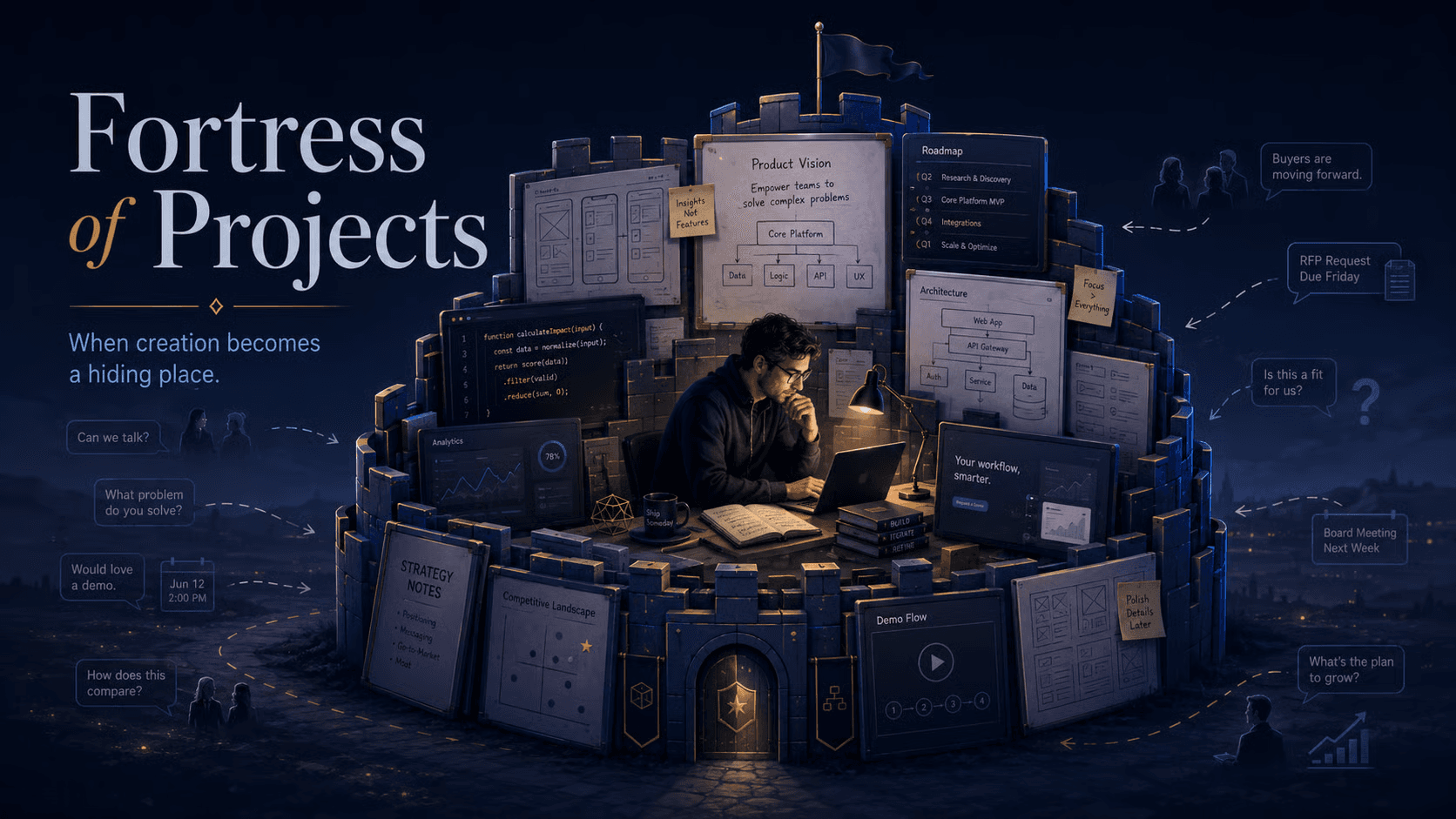
Technical founders often keep building, refining, and expanding because creation feels safer than commercial pressure. Building another feature, starting another product, rewriting the website, reworking the demo, or redesigning the framework can feel productive. But sometimes those projects become a fortress that protects the founder from the harder work: choosing one buyer, making one clear promise, and letting the market respond.
This is not because technical founders are lazy.
It is usually the opposite.
The founder is often brilliant, capable, and willing to work very hard. They can solve real problems. They can build systems. They can invent. They can see connections other people miss.
That is exactly why the trap is dangerous.
When your “happy place” is creation, it is very easy to retreat there whenever the commercial work gets uncomfortable.
The blackboard feels safe
Every technical founder has a version of the blackboard.
It might be the product roadmap. It might be the architecture. It might be a new AI workflow, a better demo environment, a new positioning deck, a cleaner website, a refined pricing model, a second product, a third product, a new category, a new market, or a new framework.
The blackboard is where everything still feels possible.
You can brainstorm. You can optimize. You can deconstruct and redesign. You can fabricate a new problem to solve. You can keep improving the thing without having to find out whether the market cares yet.
That feels like progress.
Sometimes it is progress.
But sometimes the blackboard becomes a safe refuge from the non-preferred task.
That task might be sales. It might be asking for feedback. It might be narrowing the market. It might be hearing “no.” It might be admitting that one buyer matters more than five other possible buyers. It might be putting a clear offer in front of someone and letting them judge it.
The founder tells themselves they are not avoiding anything.
They are just making it better.
That may be true for a while. But not forever.
Creation can become avoidance
Technical founders are especially vulnerable to this because building is familiar.
Engineering has rules. Systems can be improved. Architecture can be refined. Workflows can be optimized. A technical problem may be difficult, but at least it gives you something to wrestle with directly.
The market is different.
The market is messy. Buyers do not always explain themselves clearly. Feedback is inconsistent. People say nice things and still do not buy. Prospects ignore you. The person with the pain may not own the budget. The person with the budget may not feel the pain. The person who understands the product may not be able to explain it internally.
That kind of ambiguity is uncomfortable.
So the founder goes back to creation.
Another feature. Another workflow. Another offer. Another site revision. Another “almost ready” version. Another project that feels like motion without forcing the commercial question.
This can come from insecurity. It can come from fear of rejection. It can come from unfamiliarity with sales. It can come from a genuine desire to get the product right.
But whatever the root cause, the behavior often looks the same.
The founder keeps expanding the surface area instead of pressure-testing one clear path.
I am not throwing stones from a safe distance
I am very much in this club.
I have built a Production Ready framework, advisory offerings, W2 visibility paths, a PhD application path, a rebuilt website, a newsletter, a GTM idea through VC partnering, and my own subreddit.
I am not just the president. I am also a member.
Some of that work has been useful. Some of it has been necessary. Some of it has made the business more credible.
But I also know the feeling of keeping options open.
As long as every path is still possible, nothing has been rejected yet. The W2 path might work. The advisory path might work. The VC path might work. The newsletter might work. The subreddit might work. The PhD path might open doors. The website might create inbound. The next article might be the one that clicks.
While all of those options remain alive, I get to live like Schrödinger’s cat.
Both alive and dead.
Both right and wrong.
Both focused and unfocused.
Both building and avoiding.
No finality yet.
The hard part is that narrowing means saying no. One yes creates several nos. One buyer means not chasing every buyer. One offer means not explaining every possible service. One path means letting other paths wait.
That is where focus starts to hurt.
More options can hide the absence of a test
Options feel good because they preserve possibility.
But too many options can hide the fact that nothing has been tested hard enough.
A founder may have five products, three landing pages, two demos, four buyer theories, and a backlog full of clever ideas. That can look impressive from the outside. It can also mean the founder has not yet forced one product through one buyer conversation with enough clarity to learn anything useful.
That is the difference between building and learning.
Building creates more material.
Learning requires contact with reality.
If you keep changing the product, buyer, message, or offer before the market has had a fair chance to react, you are not failing forward. You are flitting.
Flitting feels active. It creates motion. It produces artifacts.
But it does not create pressure.
Failing forward is different. Failing forward means committing to one clear test, bracing for impact, learning from what happens, and making the next version stronger.
It is not fun. It is not clean. It is not as emotionally safe as the blackboard.
But it is how the company grows up.
At some point, 80% has to be enough
The 80% mark is not a hard line.
It does not mean shipping garbage. It does not mean ignoring quality. It does not mean putting something sloppy in front of the market and calling it bravery.
It means recognizing the point where additional refinement stops creating equal value.
At some point, the framework is done enough. The landing page is done enough. The demo is done enough. The offer is done enough. The message is done enough to put in front of a real person.
After that point, the next round of improvement should come from market feedback, not just founder opinion.
This is hard because founder opinion can feel safer than market feedback. You can keep fine-tuning words, sections, workflows, and features based on your own taste. You can spend days improving something in a way that may not matter to the buyer at all.
Or worse, you can make it worse.
Sometimes the extra refinement reflects your preference, not the market’s need. Sometimes the sentence you love makes the buyer care less. Sometimes the clever feature distracts from the core value. Sometimes the perfect architecture is invisible to the person deciding whether this pain is worth solving now.
There is a point of diminishing returns where effort is no longer exchanged at the same rate of value creation.
That is the point where you need to start flying the plane and finish building it in the air.
Perfection is not the same as readiness
Technical founders often confuse readiness with completeness.
They want the product to be complete before they sell it. They want the message to be complete before they post it. They want the demo to be complete before they show it. They want the market to be fully understood before they pick a lane.
That is understandable.
It is also unrealistic.
Commercial readiness does not require every possible thing to be solved. It requires enough clarity to test the next step.
Can one buyer understand the pain?
Can they see why the product matters?
Can they explain what changes if it works?
Can they tell you whether the problem is urgent?
Can they help you understand what would make this valuable, credible, or purchasable?
That is the test.
You do not need a perfect business. You need a clear enough version to create a real conversation.
Perfection is the enemy of progress, not because quality is bad, but because perfection can become a way to avoid being judged.
Pick one solution, one buyer, one painful reason to care
The practical step forward is simple. Not easy, but simple.
Pick one solution or product.
Not the whole ecosystem. Not the grand unified theory. Not every possible use case. One solution.
Then pick one buyer.
Not “enterprises.” Not “healthcare.” Not “operations.” Not “technical leaders.” One buyer who feels a specific pain and has some path to influence or purchase.
Then map the product to that buyer’s pain.
What does it save?
Time? Money? Risk? Headcount? Rework? Downtime? Delay? Customer frustration? Executive visibility?
Be as concrete as you can.
Then create one product-to-value explanation for that buyer. One way of describing what the product does, why it matters, and what changes if the buyer adopts it.
Not the complete company story.
One clear commercial path.
Then put it in front of ten people who have enough context to give useful feedback.
Ask them:
Does this make sense?
Do you know who would care about this?
Does the pain feel real?
Would this buyer have budget or authority?
What part feels unclear?
What part feels compelling?
What would make you want to see more?
Good, bad, ugly. Collect it all.
Then make the next move based on what you learned.
Do not pivot before the test has meaning
This is where discipline matters.
A founder cannot declare a test failed after two lukewarm reactions, one confusing conversation, and a LinkedIn post that got four likes.
That is not a test. That is a mood swing.
A real test needs enough consistency to teach you something.
Maybe ten credible conversations is enough for the first pass. Maybe twenty is better. The number matters less than the commitment to stay with one clear thing long enough to see a pattern.
If everyone is confused in the same place, fix that place.
If people understand the product but do not care, revisit the pain.
If the person with the pain cannot buy, map the next stakeholder.
If people care but do not believe you can deliver, strengthen the proof.
If people say it is interesting but not urgent, find the trigger event or accept that this may not be the right wedge.
That is failing forward.
You are not wandering from one idea to the next. You are moving through the bumps toward an actual GTM outcome.
Technical founders need to evolve
Technical founders are at the greatest risk of retreating to creation because creation is what made them credible in the first place.
They built the thing. They saw the problem. They had the insight. They solved what other people could not solve. That matters.
But the next stage requires a different kind of growth.
At some point, the founder has to become more than the inventor.
They have to become the translator, the tester, the editor, the seller, and the person willing to put a focused version of the work into the world before it feels completely safe.
That does not mean abandoning technical depth.
It means giving the technical depth a commercial path.
The market cannot buy everything you might become.
It can only respond to what you are clear enough to offer.
Are you building the thing, or building the hiding place?
This is the uncomfortable question.
Are you building the thing, or are you building a fortress of projects to hide from selling the thing?
The answer may not be flattering.
It is not always flattering for me either.
But it is useful.
If you are a technical founder with too many products, too many messages, too many possible buyers, too many unfinished launches, and too many “almost ready” versions, the next move may not be another invention.
The next move may be editing.
Narrow the scope. Pick the buyer. Accept the 80% version. Put it in front of people. Let the market make contact with the idea.
Then adjust.
You are smart. You will adapt.
But you cannot adapt to feedback you never let yourself receive.