
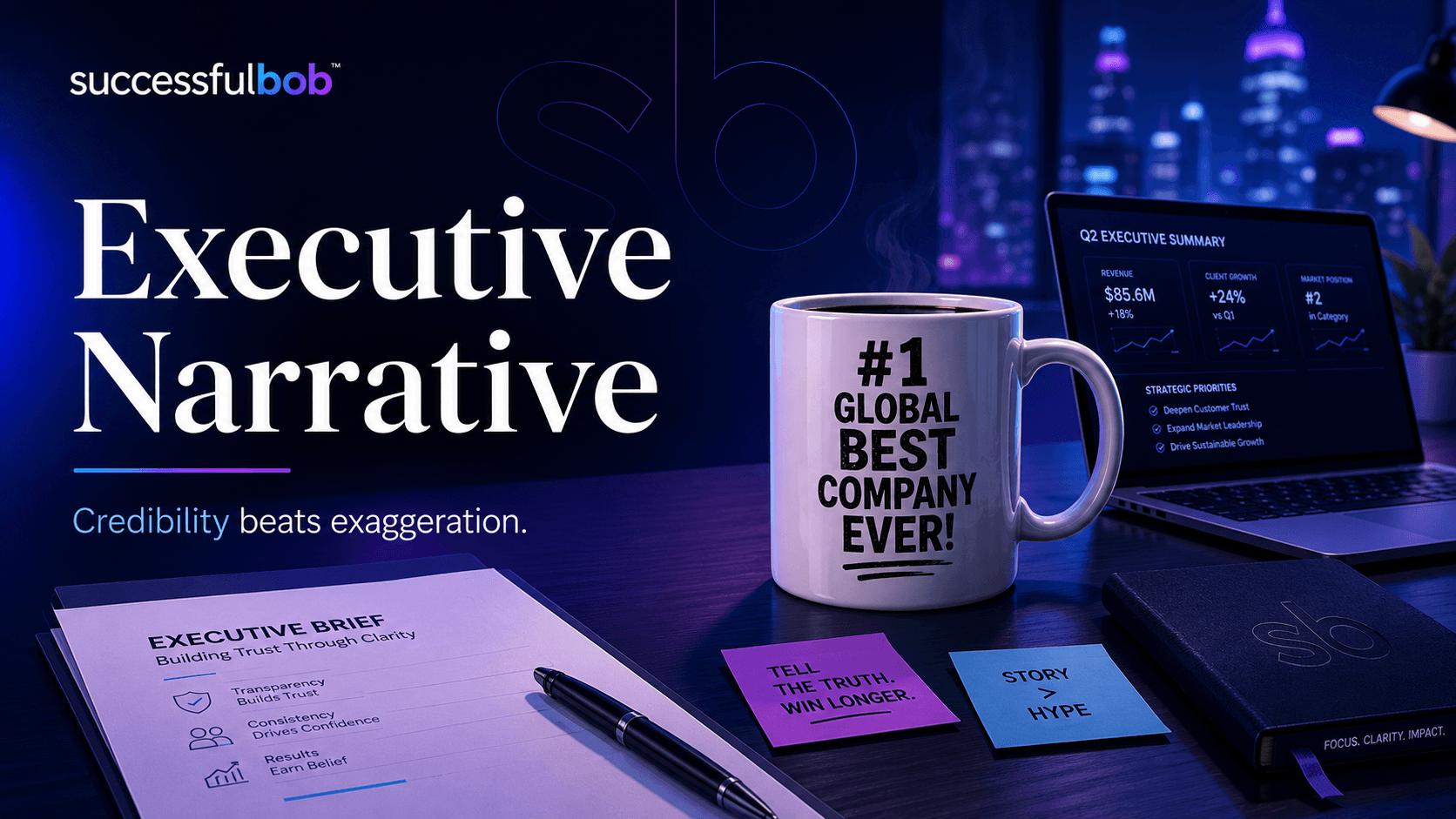
An executive narrative does not have to be universally or mathematically true. It does have to be defensible enough that a reasonable person, with access to the same facts, could come to the same conclusion.
My favorite mug says “Best DAD Ever.”
Is that objectively true? Definitely not.
Is it subjectively true? Obviously. I am the best dad my kids have ever had.
I am also the worst dad they have ever had. That is the problem with a sample size of one.
Technically, I am also their most average dad and, from a statistical perspective, their MEANest dad, despite being so nice.
Still, the mug means something to me.
Nobody bought it because I won an international parenting tournament. My kids made a judgment based on their experience, their perspective, and the evidence available to them.
Executive narratives often work the same way.
The strongest ones are not always universally true. They are meaningfully true to a particular audience, within a particular context, and supported by enough credibility that the conclusion feels earned.
Could a reasonable person reach the same conclusion?
That is the line between perspective and BS.
Could a reasonable person look at the same evidence and arrive somewhere close to the conclusion you are presenting?
If not, you may have a promising second career in manure sales.
Companies usually get into trouble when they use superlatives they cannot possibly defend.
“We are the most secure platform.”
Compared with what?
Every competitor? Every internal tool? Every open-source project? Every product that has not launched yet?
To prove “most secure,” you would need to evaluate practically everything in the category using an agreed definition of security. Most companies have done neither.
A stronger claim is:
Secure enough to be used by the Department of Defense.
That is narrower and much easier to support.
You need the Department of Defense to use it, or at least to have passed the relevant security review, rather than proving that every other product is worse.
An even stronger version might be:
The most secure platform used by the Department of Defense.
That can work if you can defend the comparison within that already credible subset.
The context does part of the work.
“Used by 80 Fortune 500 companies” follows the same pattern. It does not claim universal superiority. It gives executives a comparison point they care about: serious companies like mine have trusted this.
Executives rarely evaluate claims in a vacuum. They look for evidence that lowers perceived risk.
Who else uses it?
Who has already trusted it?
Who has successfully done what I am considering doing?
A credible narrative helps them answer those questions without pretending the company has won an imaginary world championship.
Credibility is usually borrowed
You saying you are amazing tends to create negative aura, as the kids say these days.
Or at least as my kids say these days.
Consider these two statements:
We are the easiest platform to install.
Minus 20 points for Slytherin.
Now compare it with:
“I have never installed an easier platform.”
Vice President of Operations at a recognizable peer company
One hundred points for Gryffindor!
The underlying claim is nearly identical. The credibility is completely different.
The first is self-praise. The second is evidence from someone who has actually experienced the product and whose judgment the buyer may respect.
That is why case studies and testimonials matter so much in executive storytelling.
They move the claim outside the company.
You are no longer asking the audience to believe that your marketing team finds your product impressive. You are showing that someone with a relevant problem, real consequences, and a reputation worth protecting reached the same conclusion.
Then there is data.
Nobody argues with data.
People can argue with the methodology, sample size, definitions, collection process, analysis, and interpretation. But data itself has become the closest thing business communication has to a gold standard.
If you have quantifiable evidence, use it.
Do not say the product creates faster outcomes when you can say customers reduced deployment time by 42%.
Do not say it improves efficiency when you can show that a customer eliminated 600 hours of manual work per year.
Do not say enterprises trust it when you can say 80 Fortune 500 companies use it.
A good executive narrative often follows a simple credibility ladder:
- We believe this.
- A customer experienced this.
- Multiple customers experienced this.
- The data shows this repeatedly.
- Recognizable peers have trusted this under conditions similar to yours.
The higher you climb, the less the buyer has to take your word for it.
Technically true can still be misleading
A claim can be technically accurate and still lead a reasonable person toward the wrong conclusion.
That matters because credibility depends not only on what you say, but also on what you knowingly leave out.
Imagine telling a medical company:
We can synchronize any amount of data across any location, which could save millions on your disaster recovery environment.
Technically, the platform may be able to synchronize any amount of data.
But suppose you also know the customer generates five terabytes of new data every day, and your current design would require 40 hours to move it.
The original statement is still technically true, provided nobody asks about time.
You can sync any amount of data across any location, as long as the customer has no particular interest in when it arrives.
The omitted fact destroys the conclusion you encouraged the buyer to make.
That changes the reasonable-person test.
The real question is not:
Could a reasonable person reach this conclusion from the facts I gave them?
It is:
Could a reasonable person who knew what I know reach the same conclusion?
That is a much higher standard.
An executive narrative is not credible merely because every individual sentence survives a legal review.
It must survive context.
If the information you withheld would materially change the buyer’s interpretation, the narrative is not simply incomplete. It is misleading.
This is where Product Truth and executive narrative remain connected.
Narrative gives meaning to the facts. It does not grant permission to manipulate them.
What happens when the buyer believes something else?
Sometimes the buyer’s interpretation directly opposes yours.
You can argue with them if you enjoy losing deals with style and pizzazz.
A buyer may have incorrect information. They may also have crossed into something closer to religion, where the belief is no longer open for inspection.
They believe what they believe. Period.
At that point, winning the argument may not win anything else.
The useful move is often to collect the information.
What created the belief?
Was it prior experience?
A competitor?
An analyst?
An internal stakeholder?
A technical assumption?
A failure somewhere else that they now project onto everyone in the category?
You may not be able to repair that opportunity. You can still learn how to address the same objection earlier next time.
Not every competing claim is actually competing, though.
Sometimes the buyer’s point is adjacent to yours. Sometimes it is entirely different.
You may be explaining deployment speed while they care about governance.
You may be emphasizing flexibility while they are trying to reduce operational risk.
You may be presenting cost savings while they are trying to avoid becoming the executive whose name appears in the postmortem.
That does not necessarily invalidate your narrative. It may simply mean you are telling the wrong part of the story first.
A strong executive narrative is not a speech that must survive unchanged.
It is a point of view built on defensible truth, adjusted to the decision the audience is actually trying to make.
“Best” usually needs a boundary
“Best DAD Ever” works because the claim comes with an implied boundary.
Best dad according to these children, based on their experience, within the extremely limited competitive set currently available.
That may not qualify me for the global rankings, but it makes the claim meaningful.
Companies need the same discipline.
Instead of:
We are the best platform.
Try:
We are the best fit for regulated enterprises that need to deploy AI agents without losing visibility and control.
Instead of:
We are the easiest product to use.
Try:
Operations teams at companies like yours have deployed it without dedicated professional services.
Instead of:
We deliver the fastest time to value.
Try:
Customers have moved from initial setup to production use in under 30 days.
The boundary does not weaken the claim.
It gives the claim shape.
A narrower claim that survives scrutiny is more powerful than a grand claim everyone immediately discounts.
Executive narrative is interpretation with accountability
Every executive narrative includes interpretation.
You choose which facts matter.
You decide how they connect.
You frame the consequences.
You help the audience understand why one possible conclusion matters more than another.
That does not make the narrative dishonest.
It makes it useful.
The standard is not perfect objectivity. Perfect objectivity would usually produce a product manual, not an executive story.
The standard is accountable interpretation.
Is the claim grounded in reality?
Could a reasonable person reach the same conclusion?
Have you included the facts that would materially change that conclusion?
Can customers, peers, case studies, testimonials, or data support it?
Does the context make the claim more precise rather than more deceptive?
If the answer is yes, the narrative can be both persuasive and true.
Even if nobody has officially named you the best platform ever.