
Technical companies get partners to care by connecting the product to what the partner already wants to accomplish. A partner does not care about your roadmap, your feature list, or your desire for channel revenue unless it helps them move their own business forward. The vendor has to make the partner opportunity easy to understand, easy to recognize, safe to carry, and worth acting on.
That sounds obvious.
It is not how many partner motions are built.
A lot of companies start with the wrong question:
“How do we get partners to sell our product?”
The better question is:
“Why would this partner care enough to bring us into one of their customer conversations?”
Those are not the same question.
The first one centers the vendor.
The second one centers the partner.
That shift matters.
Partners need a reason to care
A partner may not need to see a path to make $1,000,000 in margin directly from your product.
Maybe your product is the missing piece that helps them sell $10,000,000 of other products.
Maybe your solution helps lower the barrier to a larger transformation project.
Maybe it creates urgency for a professional services engagement.
Maybe it helps them deliver value faster, which lets them sell more services, keep the customer happier, or reduce risk in the implementation.
Maybe it gives their reps a cleaner reason to reopen a customer conversation.
There are multiple paths to the top of the mountain.
The mistake is assuming the only partner value story is:
“Sell our product and make money on it.”
Sometimes that is true.
Sometimes the better partner story is:
“Use our product to sell more of what already matters to you.”
That is especially true in complex technical ecosystems where partners already have a portfolio, existing vendor relationships, services margins, customer trust, and account strategies.
A technical company needs to understand which of those levers matter before asking a partner to care.
Partner access is not partner readiness
Getting a contract signed is often an easy part.
Getting a partner onboarded is often an easy part.
They can also be the riskiest parts.
If the vendor is not ready to deliver on why the contract was signed or why the relationship was created, the company can lose momentum quickly.
You may only get one real at-bat with certain partners.
If the first enablement session is vague, the first customer conversation is confusing, or the first handoff creates risk, the partner may not come back for a second try.
That is why partner access is not the same as partner readiness.
Access means you got into the room.
Readiness means the partner knows what to do once you are there.
The vendor needs the value translation, frameworks, GTM motions, partner education, and handoff model ready while the momentum is still alive.
Otherwise, the relationship exists on paper, but nothing moves in market.
Partners are risking relationship currency
Partners do not just sell products.
They spend relationship currency.
When a partner brings a vendor into a customer conversation, they are putting some of their credibility on the line.
That means they need to understand product truth.
They need to know what can be delivered.
They need to know what cannot be delivered.
They need to know what is technically possible, but not something they should promise casually.
They need to know what happens after they make the introduction.
The vendor may be excited about the opportunity.
The partner may be thinking:
“If this goes badly, I am the one who has to face the customer.”
That is why the partner story has to be honest.
Do not arm partners with inflated claims.
Do not make them carry vague promises.
Do not hide limitations until the customer is already in the room.
If partners are going to trust you with their relationships, they need to know that your product truth can survive the sales conversation.
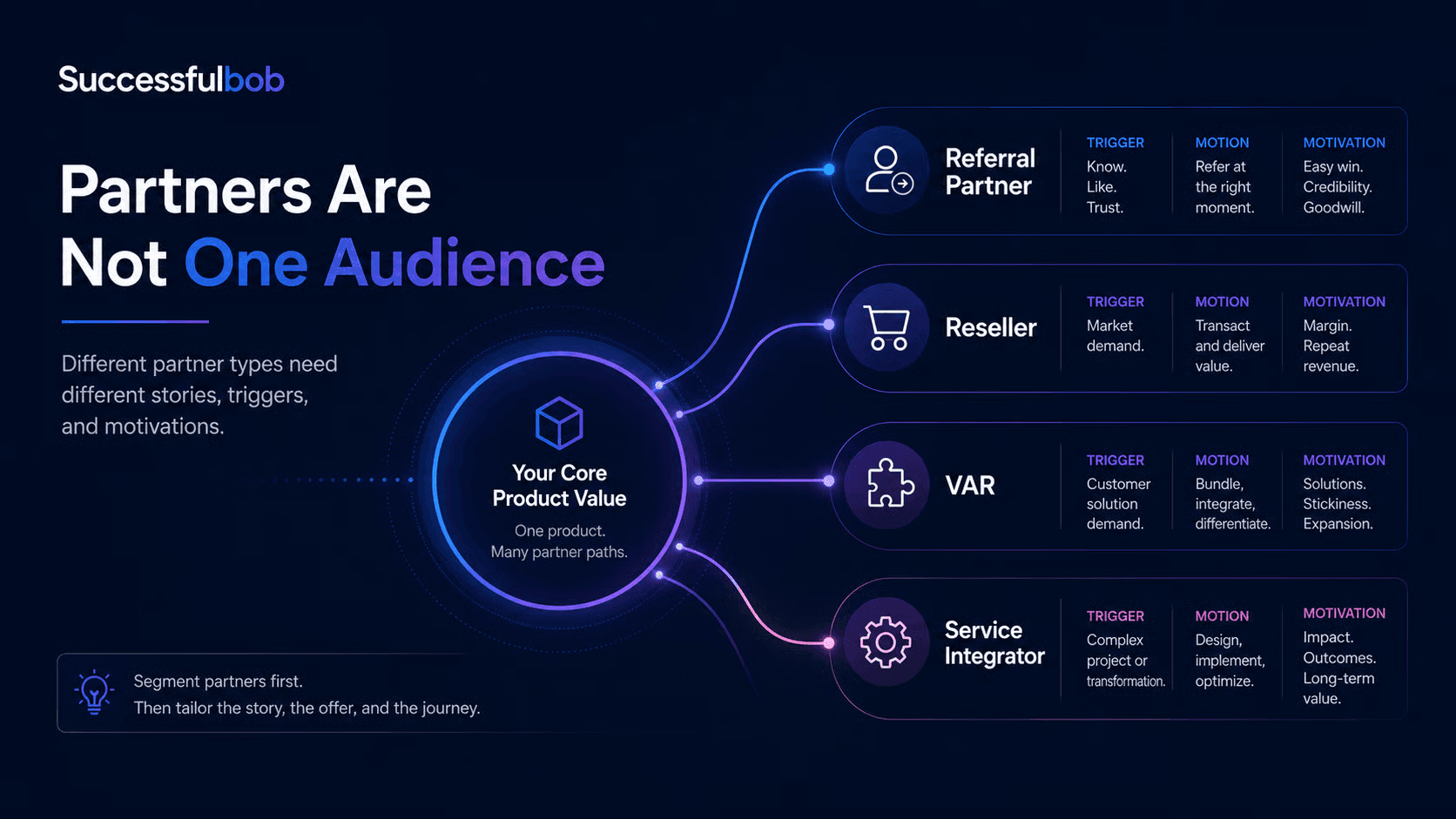
Different partner types need different motions
Not every partner is motivated by the same thing.
A reseller does not behave like a service integrator.
A referral partner does not behave like a distributor.
A large national VAR does not behave like a boutique implementation shop.
Each partner type has its own motion, economics, attention span, and success criteria.
Some partners need to sell confidence, execution, and services.
Some care about moving large volumes of low-margin commodity products.
Some specialize in a handful of solutions and represent those to larger national VARs that cannot realistically spend time understanding every vendor in their catalog.
Some only need to know when to make an introduction.
Some need deep technical enablement before they will trust the solution.
Some are looking for attach opportunities.
Some are looking for services expansion.
Some are looking for a way to make their existing vendor portfolio work better together.
The same product may need a different partner story for each of those motions.
That is not a messaging flaw.
That is the reality of partner GTM.
The economic story has to be obvious
Partners are not nonprofit extensions of your sales team.
They need to understand how the motion helps them.
That does not have to be crass.
It does have to be clear.
Selling this solution in this manner should help move their needle.
That might mean:
·direct resale margin
·more professional services
·larger transformation projects
·faster implementation
·reduced delivery risk
·stronger customer retention
·easier expansion into existing accounts
·more pull-through for adjacent products
·more credibility with a strategic buyer
The vendor’s job is to make that value easy to see.
Then equip the partner to act on it.
If the partner has to work too hard to figure out why your product helps them, they probably will not bother.
They already have other products to sell.
They already have other vendors asking for attention.
They already have customer work in front of them.
Your job is not to make them admire your product.
Your job is to make them see the motion.
Partners need to know what to listen for
A good partner motion gives the partner a trigger.
What should they hear in a customer conversation that makes them think of you?
The answer depends on the type of partner.
For a referral partner, a few keywords may be enough.
If the customer mentions a certain project, pain, tool, migration, compliance issue, integration problem, or transformation initiative, the partner knows to introduce you.
For an integration partner, the trigger may be more specific.
They may need to look for a certain technical foundation, a certain workflow dependency, or a transformation initiative that requires your product to be successful.
For a service integrator, the trigger may be hidden inside the implementation.
They may see that the customer is setting up a business continuity or disaster recovery environment, and know that your solution helps make the urgency story stronger.
For a national VAR, the trigger may need to be simple enough for a rep who carries thousands of products.
They need a clear customer situation, not a technical thesis.
That is why a good partner enablement question is:
“If one of their reps had 90 seconds with a customer, what should make them think of us?”
If you cannot answer that, the partner probably cannot either.
The handoff needs to be safe and simple
Partner motions break when the handoff is unclear.
Who qualifies the opportunity?
Who explains the product?
Who owns discovery?
Who registers the deal?
Who does the demo?
Who handles technical validation?
Who protects the partner’s economics?
Who owns delivery?
What happens if the customer asks for something the product does not do?
What happens if the partner overpromises?
These are not administrative details.
They are trust details.
A partner is more likely to bring you into a deal when the handoff feels safe.
They need to know the vendor will not embarrass them, confuse the customer, steal the relationship, or create unnecessary risk.
The basics matter:
·product truth
·feature-to-value translation
·partner education
·clear trigger points
·clean handoff rules
·honest limitations
·simple enablement
·defined economics
Without those, partner interest does not become partner motion.
A simple exercise before approaching partners
Before approaching partners, start with three or four partner types.
For example:
·reseller
·VAR
·service integrator
·referral partner
Then answer three questions for each one.
What is the trigger?
What would happen in their world that should make them think of your product?
What should they do?
Should they refer, resell, bundle, introduce, implement, register a deal, bring you into discovery, or include you in a larger solution?
Why should they act?
How does acting on that trigger help them make money, protect the customer relationship, sell more services, reduce risk, accelerate delivery, or sell more of what they already care about?
Here is a simple example.
Imagine you sell a product that detects a large number of permission changes on file objects.
For a service integrator, the trigger might be:
“This customer is setting up a business continuity or disaster recovery environment.”
The action might be:
“Include this solution as part of the proposed architecture so the customer can detect signs of an attack or risky permission change before the recovery strategy is compromised.”
The motivation might be:
“This helps the integrator tell a stronger urgency story, gives the customer a clearer reason to act now, and increases the size and value of the services engagement.”
That is a partner motion.
It is not just:
“Please sell our product.”
It is:
“Here is the customer situation. Here is what to do. Here is why it helps you.”
Partner GTM requires product truth and value translation
Partner GTM is not magic.
It requires the same foundations as every other technical GTM motion.
You need product truth.
You need product messaging.
You need feature-to-value translation.
You need a buyer story.
You need a partner story.
You need to understand what the product does, what it does not do, and where it creates value in the real world.
Then you need to package that value differently by partner type.
A service partner may need to understand the implementation and delivery value.
A reseller may need to understand the customer pain and economic hook.
A referral partner may need to recognize a few trigger phrases.
A distributor may need to understand how your product helps the portfolio sell better.
A national VAR may need a simple, repeatable reason for a rep to bring you into a customer conversation.
The same product can support all of those motions.
But not if the vendor treats every partner the same.
The goal is partner repeatability
Good partner GTM does not start with the partner agreement.
It starts with the partner’s reality.
What are they already trying to sell?
Where do they already have trust?
What customer pain do they already see?
What work do they already perform?
Where does your product help them move faster, sell more, reduce risk, or make the customer more successful?
If you can answer those questions clearly, partners have a reason to care.
If you cannot, the partner agreement may still get signed.
It just may never turn into motion.
Want help making your partner story repeatable?
Production Ready helps technical companies turn product truth into buyer-ready and partner-ready GTM.
That includes the messaging, demo flow, partner story, enablement structure, handoff model, and executive narrative needed to help partners understand when to care and how to act.
If your product is strong but partners are not carrying the story yet, that is fixable.
Schedule a 30-minute fit call: https://calendar.app.google/7whsjgVTFPQNQ7oE6