
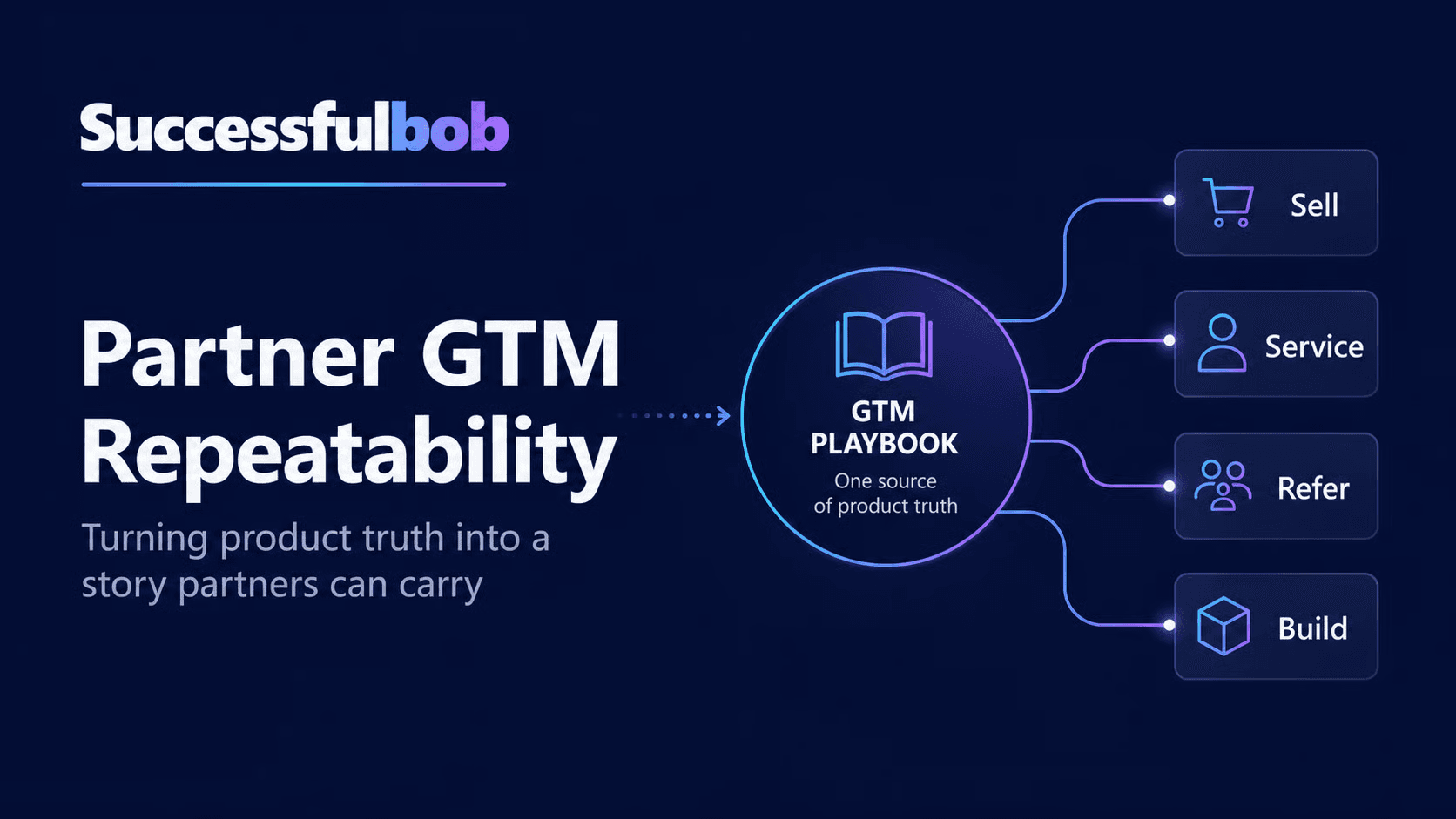
Technical companies make partner GTM repeatable by doing the translation work twice. First, they need to understand their own direct selling motion: who they sell to, what pain they solve, how product features map to value, and what proof matters by buyer role. Then they need to translate that story into the partner’s world: how the partner makes money, how the partner sells, what role they want to play, and what will make the motion easy enough to repeat.
A lot of companies treat partner enablement like a handoff.
Here is the deck.
Here is the product training.
Here is the referral agreement.
Here is the portal.
Now go sell.
That rarely works.
Partners have their own business to run. They have their own customers, their own services, their own sales motion, their own incentives, and their own list of vendors asking for attention.
If your story only makes sense inside your company, it probably will not become repeatable through a partner.
Partners need more than your direct sales story
A vendor has to understand its own sales motion before it can expect a partner to carry it.
That means doing the hard work first.
What does the product actually do?
Who is the ideal customer?
Which roles care?
Which pains are real enough to create urgency?
Which features support which value stories?
Which proof points matter?
What does the product not do?
What objections are likely?
What demo flow helps the buyer believe?
That work matters because partner GTM adds another layer of translation.
A service partner may care about how your product improves services margin, creates implementation work, increases customer stickiness, or helps them deliver a better outcome.
A selling partner may care about pull-through sales, margin, attach opportunities, speed to close, or whether your company is easy to work with.
A referral partner may not want to carry the whole story. They may only need to know what a good opportunity looks like and when to call you.
Those are different partner motions.
They should not receive the exact same enablement.
The partner has a full catalog
Most partners are not sitting around waiting for your product.
They already have a catalog.
They already have vendor relationships.
They already have sales priorities.
They already know which vendors are easy to work with and which ones create friction.
That is the competitive reality of the channel.
A vendor needs to make three things clear quickly:
Why this product is meaningfully different.
Why it is easy to sell.
Why it helps the partner make money.
That last point can make people uncomfortable, but it should not.
Channel reps are motivated by incentives too. They care about margin, deal protection, attach revenue, services opportunity, account control, and whether the vendor will make them look good in front of the customer.
People also like working with people they like.
That sounds simple, but it matters.
If your company is hard to work with, slow to respond, unclear on rules, or inconsistent on deal support, partners will remember that.
A repeatable partner motion is not only about having the right story.
It is also about being a vendor worth carrying.
Not every partner wants the same seat
Partners come in different forms.
Some want to be in the driver’s seat.
Some want to be in the passenger seat while you drive.
Some are happy to sit in the trunk and make a referral when they see the right opportunity.
That is not a problem.
It only becomes a problem when the vendor treats every partner like they should play the same role.
A delivery-heavy services partner may want deep training. They may need enough product and sales engineering depth to run much of the deal, deliver the work, and speak credibly with technical buyers.
A strategic alliance partner may care more about market alignment, executive narrative, and joint account strategy.
A referral partner may only need a simple signal: “If a customer says cloud transformation, call us.”
A marketplace partner may need packaging, procurement simplicity, and a clear reason for the buyer to transact that way.
A boutique partner may have a narrow but trusted relationship with a specific buyer community.
A VAR may care about margin, attach rate, registration, and competitive differentiation.
A systems integrator may care about services pull-through, delivery model, and whether the product creates repeatable work.
They are all beautifully made.
They just are not the same.
Repeatable partner GTM does not force every partner into one mold. It gives each type of partner the enablement needed to play its role well.
Treat a partner like a prospect
A partner is not an internal employee with an external logo.
A partner is an audience.
That means the message has to meet them where they live.
The same way you would not explain a technical product to a CFO the same way you would explain it to a CISO, you should not explain your partner opportunity the same way to every partner.
A security-focused partner will hear the story through security value, risk reduction, governance, compliance, and trust.
A services partner may hear it through implementation work, margin expansion, delivery efficiency, and customer retention.
A reseller may hear it through attach opportunity, compensation, ease of transaction, and deal support.
A platform partner may hear it through ecosystem fit, product adjacency, customer expansion, and strategic value.
If you speak only from your own strengths, the partner has to translate the opportunity themselves.
Some will.
Most will not.
The vendor’s job is to make the partner opportunity easy to understand, easy to remember, and easy to act on.
Pipeline conversion tells the truth
One of the easiest ways to measure partner GTM is pipeline conversion.
You can learn a lot from the shape of partner-sourced pipeline.
If there are a lot of referrals but they do not close, the partner may like your story, but they may not be equipped to find the right opportunities or message the value clearly.
If there are no opportunities, or the opportunities seem random, the partner may not have the memory or confidence to pitch your solution.
If there is a steady, even low amount of pipeline that converts well, the partner probably gets it. That may be a sign to expand the motion into another pain point, buying role, campaign, vertical, or sales motion.
Pipeline volume matters.
But conversion tells you whether the story is actually landing.
A partner who sends a small number of well-qualified opportunities may be much more valuable than a partner who sends a large number of weak ones.
The goal is not just activity.
The goal is repeatable, qualified, explainable partner motion.
Repeatable partner GTM needs operating rhythm
Partner enablement is not a one-time event.
It needs rhythm.
Partners need regular transfer of knowledge.
They need to know what changed in the product.
They need new campaigns.
They need updated proof points.
They need competitive updates.
They need to understand which buyers are responding and which stories are working.
When co-selling happens, there should be an alignment call.
Who is leading?
Who owns discovery?
Who is handling the demo?
Who is covering technical validation?
Who is managing procurement?
When does the vendor step in?
When does the partner stay in front?
Without that alignment, the buyer can feel the seams.
A certification or structured onboarding process can also help. Not because certificates magically create partner success, but because they make it easier to onboard new partner reps, SEs, and delivery teams without starting from scratch every time.
The goal is fresh transfer models.
Partners change.
Reps leave.
New SEs join.
Products evolve.
Campaigns shift.
The partner motion has to survive that churn.
Prevent overreach with a clear transition point
A good partner should be able to explain the product confidently.
But they should not be forced to overextend.
There is a balance.
The partner needs to know enough to identify real interest, explain the value, and carry the early conversation.
They also need to know where the safe line is.
At what point should they register the deal?
When do they get deal protection?
When should the vendor join?
When does a technical expert need to enter the conversation?
When is the partner still creating value, and when are they risking confusion by going too far alone?
This protects everyone.
It protects the buyer from getting an inaccurate story.
It protects the partner from making promises they cannot support.
It protects the vendor from having to unwind mispositioned opportunities.
It also gives the partner confidence.
They do not need to know everything.
They need to know enough to get to the right transition point.
A useful test: ask a partner to design the room
Here is a practical exercise.
Pick a partner you think understands your product.
Then ask them this:
“If we gave you a budget for an in-person event, who would you invite, from what types of companies, and what would you tell them to get them in the room?”
That question tests a lot.
Does the partner understand your buyer?
Do they understand the pain?
Do they understand the value?
Do they know which companies are likely to care?
Do they know what message would make someone show up?
Do they understand the potential ROI for you?
Do they understand the potential ROI for themselves?
If the answer is vague, your partner story may not be ready.
If the answer is sharp, you may have a real channel motion to test.
And if the business case makes sense, do it.
In-person is still one of the best ways to sell, especially in a world that is getting flooded with AI-generated outreach, AI-generated content, and AI-generated noise.
A good room with the right partner and the right buyer can create more signal than a dozen generic campaigns.
Partner repeatability depends on the whole GTM system
Partner GTM is not isolated.
It depends on everything else being clear.
You need product truth, because partners need to know what the product is and what it is not.
You need buyer translation, because partners need to know who cares and why.
You need product marketing support, because partners need battlecards, objection handling, competitive intel, campaign language, and proof points.
You need demo flow, because partners need to know how the product should be shown, not just described.
You need executive narrative, because partners often need to help your story reach people above the practitioner level.
You need market readiness, because partners can amplify your message only if the message is ready to travel.
Partner repeatability is one of the clearest tests of whether the story is real.
If your own team can barely carry the message, partners will not magically make it cleaner.
But if the story is clear, the buyer is defined, the pain is mapped, the proof is credible, and the handoff is clean, partners can become a powerful extension of your GTM motion.
That is when partner GTM becomes repeatable.
Not because the partner memorized your pitch.
Because the partner understands where your product fits, who it helps, how it creates value, and when to bring you in.
Want help making your partner GTM repeatable?
If your partner motion depends too much on individual relationships, random referrals, or one-off co-selling, that is fixable.
Production Ready helps technical companies turn product truth into buyer-ready messaging, demo flows, partner enablement, and executive narratives that sales, partners, and leadership can repeat.
Schedule a 30-minute fit call: https://calendar.app.google/7whsjgVTFPQNQ7oE6