
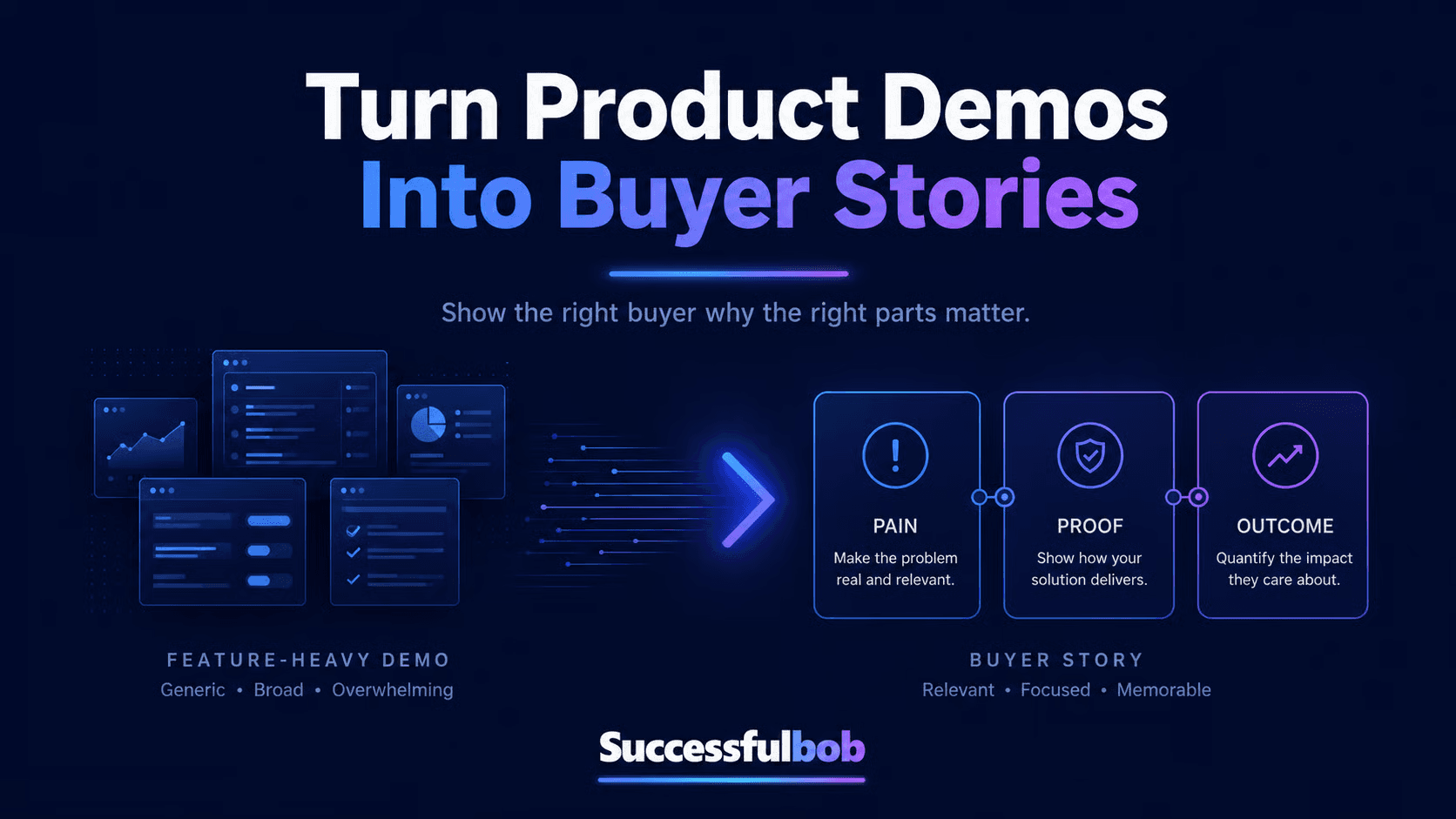
Technical companies turn product demos into buyer stories by stopping the product tour and building the demo around what the buyer needs to believe. The demo should verify the buyer’s pain, show only the features that support the desired outcome, and make the path from product capability to business value feel logical, credible, and repeatable.
A good demo is not that different from explaining something to a friend or spouse.
You understand what they care about. You do not explain every technical detail you know. You only use the details that help them understand the point you are trying to make.
That is what a technical demo should do.
It should not be a walkthrough of every feature the product team is proud of. It should be a guided story that helps the buyer conclude, “Yes, this solves a problem I actually have.”
Most demos are feature shows
The most common demo problem is not that the product is weak.
It is that the demo is built like a feature checklist.
The presenter has a script. The script has features. The features are shown in product order. The audience gets spoken at instead of spoken to.
That can work if the audience already knows exactly what they are looking for and only needs validation. But most of the time, the buyer is still trying to understand whether the product matters to them.
If the demo shows a feature the buyer does not care about, it creates drag.
If the demo explains a capability without tying it to a pain, it creates noise.
If the demo spends too much time proving how smart the product is, the buyer may miss why the product is useful.
Technical buyers do care how something works. But even technical buyers need the “why this matters” thread to stay intact.
Start by verifying assumptions
A demo should not start with the product.
It should start by verifying assumptions.
The company may believe the buyer has a certain pain. The seller may have heard something in discovery. The marketing team may have built the story around a common use case.
But the demo only works if that pain is actually the buyer’s pain.
Before showing the product, the presenter should confirm the destination:
·Is this the problem you are trying to solve?
·Is this where the current process breaks?
·Is this the outcome that would matter most?
·Is this the role or workflow we should focus on?
The best demos are not rigid scripts. They are combinations of reusable story pieces that can be arranged to fit the audience in the room.
That does not mean the demo is improvised chaos. It means the team knows the product well enough, and understands the buyer well enough, to show the right parts in the right order.
A buyer story still needs product proof
There is a risk in saying “tell a story” because some people hear that as “make the demo less technical.”
That is not the point.
A buyer story still needs product proof.
The product has to be real. The workflow has to make sense. The buyer has to believe the product can actually do what the story claims.
For technical products, I often like starting with enough of the boring bits to establish credibility. Show how the product works. Prove that it is not vapor. Give the audience enough confidence that the foundation is sound.
Then move quickly into the story:
Since you can see how the product does this, here is how these capabilities work together.
Since these capabilities work together, here is the result they create.
Since this result is possible, here is how it addresses the pain you told us mattered.
That is where the demo starts to become a buyer story.
Not “here are ten features.”
More like:
“Here are the few capabilities that matter for your problem, and here is how they work together to create the outcome you care about.”
The audience is bigger than the room
In technical sales, the buyer is rarely one person.
You may be demoing to a practitioner, their manager, and a technical evaluator. But the CIO, CFO, CISO, procurement team, or another executive may still be part of the buying process later.
A good demo serves the people in the room and prepares them to carry the story to the people who are not in the room.
If the practitioner is watching, the demo should show how the product makes their day-to-day work easier.
If the manager is watching, the demo should show how the product helps the team perform better, reduce risk, move faster, or operate with less friction.
If the CIO will eventually need to approve the investment, the demo should give the people in the room a clean way to explain why the product matters beyond the feature level.
That is the real test.
Can the people who saw the demo explain the value to the next person?
If they cannot, the demo may have been technically accurate but commercially weak.
Features are useful when they prove something
Features are not bad.
A technical product needs features. A demo needs to show enough of them to create confidence.
The problem is showing features without a job to do.
A feature should appear in the demo when it does at least one of three things:
First, it adds credibility. It proves the product is real, mature, or technically sound.
Second, it supports the value translation. It helps the buyer see how the product creates the outcome being discussed.
Third, it prevents a future objection. For example, if you know a security review is coming, showing the right security capability early may prevent the buyer from assuming the product will get blocked later.
But if a feature does not add credibility, support the story, or reduce a likely objection, it may not belong in that version of the demo.
That does not mean the feature is unimportant.
It means it may not be important to this buyer, in this conversation, at this stage of the deal.
Silence is usually a bad sign
One of the clearest signs a demo is working is that the audience starts asking questions.
Not random questions. Not confused questions. Not “wait, what does this do?” questions because the story broke.
The best questions are buying questions:
·Could this work with our current process?
·What happens if this team uses it differently?
·Can we show this to security?
·How would this change for another department?
·What would implementation look like?
·Can we bring in the person who owns that workflow?
That is when the demo becomes a conversation.
In the ideal version, the buyer starts guiding the demo. They ask about the things they care about, and the presenter shows how the product supports those concerns.
Silence can mean the room is politely waiting for the demo to end.
Questions mean the audience is mentally placing the product into their world.
A simple exercise for your next demo
Pick one buying persona.
Pick one concern that persona has.
Then rebuild one section of your demo around that concern.
Show, as respectfully of their time as possible:
·how your product addresses the concern
·what outcome it supports
·why it sufficiently solves the problem
·what proof or anecdote makes it believable
·what related workflow shows this is part of a broader solution, not a one-off trick
That exercise will quickly expose whether your demo is a buyer story or just a feature tour.
If each section of the demo cannot answer “who cares and why,” the audience probably cannot answer it either.
The best demos feel short
A great demo does not need to show everything.
It needs to show enough.
Enough to prove the product is real.
Enough to prove the product understands the buyer’s world.
Enough to show how the product logically supports the desired outcome.
Enough to give the buyer confidence that when the next stakeholder joins the conversation, the story can be adapted for them too.
That is what makes a demo scalable.
When the security person joins, you can show why security should care.
When finance joins, you can show why finance should care.
When the executive sponsor joins, you can show why this matters at the business level.
The demo becomes a set of reusable feature-value modules that can be assembled into a story for the audience in front of you.
That requires knowing the full product truth. It requires knowing the value by role. And it requires knowing which product moments prove which buyer outcomes.
That is how technical companies turn demos into buyer stories.
They stop trying to show the whole product.
They start showing the right buyer why the right parts matter.
Want help pressure-testing your demo story?
If your demo still feels more like a product tour than a buyer story, that is fixable.
Production Ready helps technical companies turn product truth into buyer-ready messaging, demo flows, and field stories that sales, partners, and executives can repeat.
Schedule a 30-minute fit call: https://calendar.app.google/7whsjgVTFPQNQ7oE6