
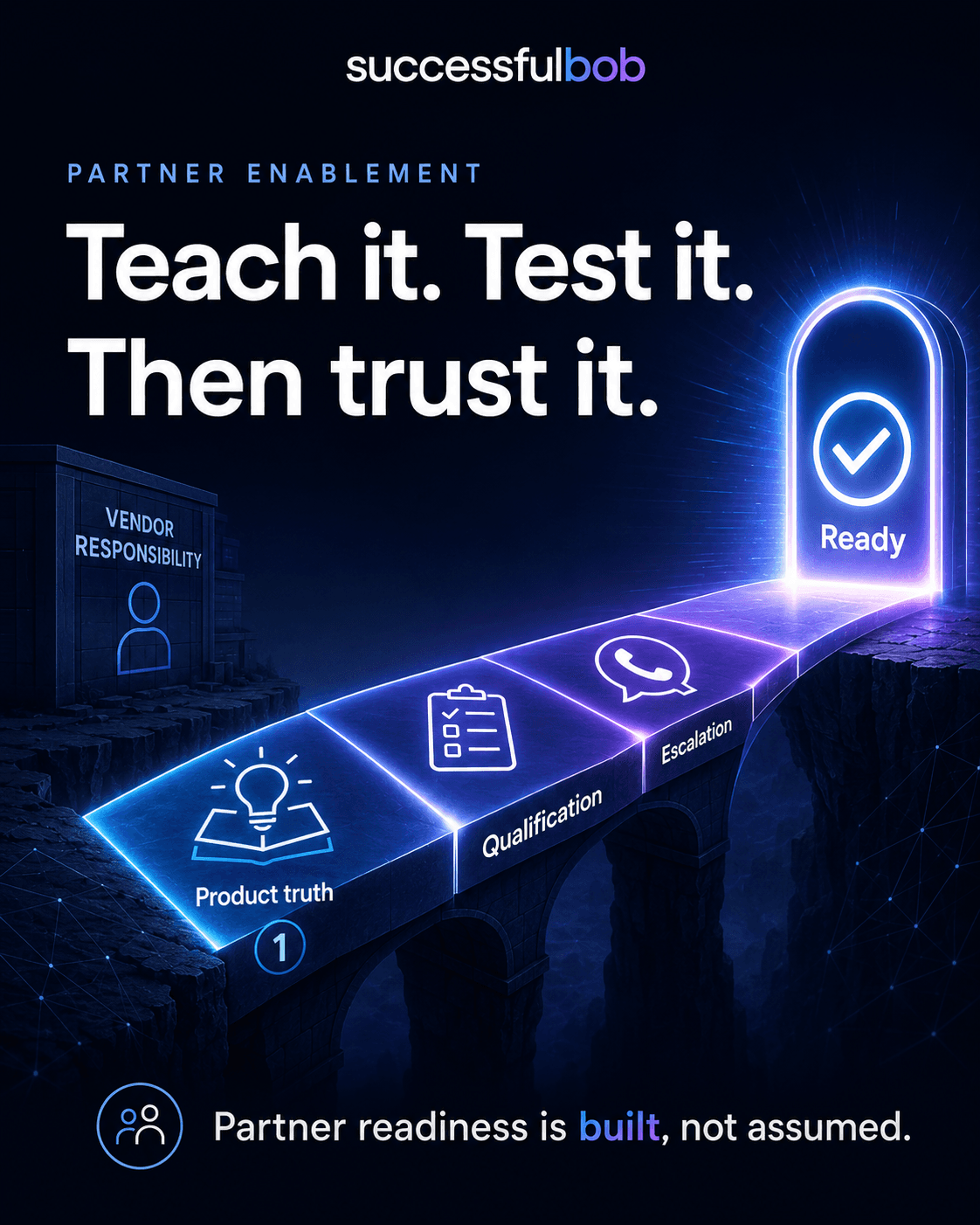
A partner is ready to sell your product when they can recognize a legitimate opportunity, explain why the customer should care, understand what your product can and cannot do, and know when to bring your team into the deal.
That is a much higher bar than completing onboarding, watching a video, or earning a green checkmark in a partner portal.
Most companies confuse training completion with readiness. They are not the same thing.
A partner may have completed every required module and still be unable to pick your product out of a police lineup against the three little pigs. I am not convinced every partner can do that at first.
Training completion proves almost nothing
The traditional definition of partner readiness is usually administrative.
Did they:
- attend onboarding?
- watch the enablement video?
- download the sales deck?
- complete the certification?
- click through the portal?
Congratulations. The dashboard is green.
That does not mean the partner understands:
- what your product actually does
- how it differs from the alternatives
- what customer pain it legitimately solves
- what it cannot do
- why the customer should care
- why the partner should care
That last one gets ignored more than it should.
You expect the partner to sell your product. How does selling it help them?
Does it help them protect a strategic account? Create services revenue? Strengthen another part of their portfolio? Open conversations they could not previously have? Solve a recurring customer problem that makes them look smarter?
A partner is not your unpaid sales team. There has to be value for them too.
Readiness does not always mean selling alone
One of the clearest signs of readiness is that the partner identifies the right opportunities and passes them to the vendor sales team.
That is not failure.
Some partners may prefer to operate that way long term, and that can still create a very successful GTM motion.
At companies where I have worked, we used to say that sometimes the partner wants you in the driver’s seat, sometimes they want you in the passenger seat, and sometimes they want you in the trunk.
All three can work.
The right operating model depends on:
- the partner’s understanding of the product
- their confidence level
- their relationship with the customer
- their technical capability
- how much control they want over the opportunity
A partner does not need to run every deal independently to be valuable. They do need to recognize where you fit and bring you into the right conversations.
Product Truth is the most important thing they need to understand
Before a partner learns your pitch, your demo, or your competitive positioning, they need a solid grasp of Product Truth.
They need to understand:
- what you can do
- what you cannot do
- where the product works
- where it does not work
- what conditions must be true
- where the limits begin
This matters because a poor-fit opportunity costs far more than one purchase order.
When a partner recommends your product to one of their customers, they are staking their credibility on you.
If your product cannot deliver what the partner promised:
- you may lose the deal
- the partner may damage the customer relationship
- you may lose the partner
- the partner may stop bringing you future opportunities
- you may lose several customers you never knew were in play
Money costs one dollar for one dollar.
Reputation can be priceless.
That is why partner enablement cannot be built on optimistic half-truths. If the product has boundaries, the partner needs to know them before they put their name behind it.
The minimum qualification standard is not complicated
A partner seller does not need to know every feature.
They should be able to answer four basic questions:
- Does the customer have a real pain?
- Can the customer put a name on that pain?
- Is it a pain your product can legitimately solve?
- Is there any realistic path for the customer to purchase and successfully use the product?
If those conditions are met, the opportunity is probably fair game.
That does not mean the partner has fully qualified the deal. It means they have identified something worth pursuing without randomly throwing your company into every account that uses technology.
Poor partner qualification often looks like enthusiasm.
There is activity. There are introductions. Everyone seems busy.
Then none of the opportunities convert because the partner has learned how to say your company name but not how to identify a customer who should buy from you.
Different partner roles require different levels of readiness
A partner seller, partner SE, and service delivery partner should not all be certified against the same standard.
Their jobs are different.
Partner sellers
A seller needs to identify a valid opportunity.
They should understand:
- the buyer pains to listen for
- the roles who care
- the basic value
- the obvious disqualifiers
- when to bring in the vendor
They do not need to become deeply technical. They need enough understanding to avoid wasting everyone’s time.
Partner SEs
An SE needs to portray a realistic solution.
They need to understand:
- how the product works
- what it does and does not support
- which scenarios are viable
- which limitations matter
- how to demonstrate the right workflow
Their job is not to produce a feature tour. Their job is to show how the product addresses the customer’s actual problem.
Service delivery partners
Delivery partners need to produce functioning outcomes.
They need to understand:
- configuration order
- technical dependencies
- required customer inputs
- implementation risks
- what successful operation looks like
Each role requires a higher level of product knowledge and aptitude before it can operate without supervision.
That should be reflected in separate enablement tracks.
Certifications without assessment create false security
Any certification that does not test understanding is mostly theater.
People will play your training on mute while they sit in another meeting, answer email, or play a game on their phone.
They will click Next.
They will reach the end.
Your dashboard will show a happy green number.
You will have accomplished nothing.
If the goal is simply to create a green dashboard, I can show you how to do that in markup or CSS and save everyone the time.
Partner readiness should be demonstrated, not inferred from content consumption.
Stop showing features without explaining why they matter
Companies routinely overtrain partners on product details and undertrain them on customer problems.
This is the same mistake they make in marketing and demos.
Do not show someone a thing without explaining why they need to see the thing.
Nobody wants a feature tour.
Not your customers. Not your partners. Not their SEs. Not your spouse. Not a confused child. Nobody.
Stop doing them.
Partner sellers need pain cues. They need to know what to listen for and what questions to ask.
Partner SEs need to understand that the product works and how to show it working.
Service delivery partners need to understand how to get it working.
That is a much more useful enablement structure than making every role sit through the same product walkthrough.
Readiness should be tested by role
A useful partner-readiness program should contain assessments tied to the work each role will perform.
For a seller track, test whether they can:
- match customer pains to the right buyer roles
- identify valid and invalid use cases
- explain why the customer should care
- distinguish what the product does from what they wish it did
- recognize when an opportunity should be escalated
If they paid attention, these questions should be easy.
If they did not, they will often choose the answer they want to be true.
That answer will be wrong because your product does not run on pure magic and unicorn laughter.
For an SE track, use scenarios.
Give them situations that would and would not work based on the product capabilities and limitations covered in the training.
Ask them to explain:
- whether the scenario is viable
- what conditions must be true
- what the product would actually do
- where the vendor needs to be involved
For service providers, test execution.
Ask them to:
- choose the correct order of configuration
- identify dependencies
- diagnose likely failure points
- explain how to set up the workflow
- show that the result actually works
This is harder than counting video completions.
It is also useful.
A partner should ask for help before they overpromise
There is no universal rule for when a partner should bring the vendor into a deal.
They should handle what they genuinely know they can handle.
If they are 100 percent confident, take the shot.
If they are 90 percent confident, ask for clarification.
That does not always require putting the vendor on a call with the customer’s CEO. It might be a text, a quick call, or a short message to confirm one detail.
Customers generally do not expect a partner to know every fact about every vendor.
They do expect the partner to avoid making things up.
Getting clarification makes the partner look responsible. Overpromising makes everyone look bad.
The first warning sign is a flood of poor-fit opportunities
When partners are declared ready too early, the first symptom is usually bad pipeline.
They begin shotgunning opportunities because they are excited but cannot qualify.
That creates:
- wasted sales time
- wasted technical resources
- poor customer conversations
- frustration on both sides
- lots of activity with very little value
It also burns the honeymoon period.
Early in a partner relationship, the partner is paying attention. They are curious. They are willing to experiment.
If their first ten opportunities go nowhere because nobody taught them how to identify a real fit, they lose interest.
That is the best time to catch the problem.
If you do not, it can evolve from inefficiency into liability. The partner may begin misrepresenting the product, overpromising capabilities, or creating customer expectations your company cannot meet.
Partner readiness is observable behavior
The real question is not whether the partner completed training.
It is whether they can do the job.
A ready partner can:
- recognize a real opportunity
- identify the customer pain
- connect that pain to your product
- understand the product’s boundaries
- explain why the customer and partner should care
- involve the vendor at the right time
- avoid putting their reputation, and yours, behind something that will not work
That is readiness.
Everything else is a progress bar.