
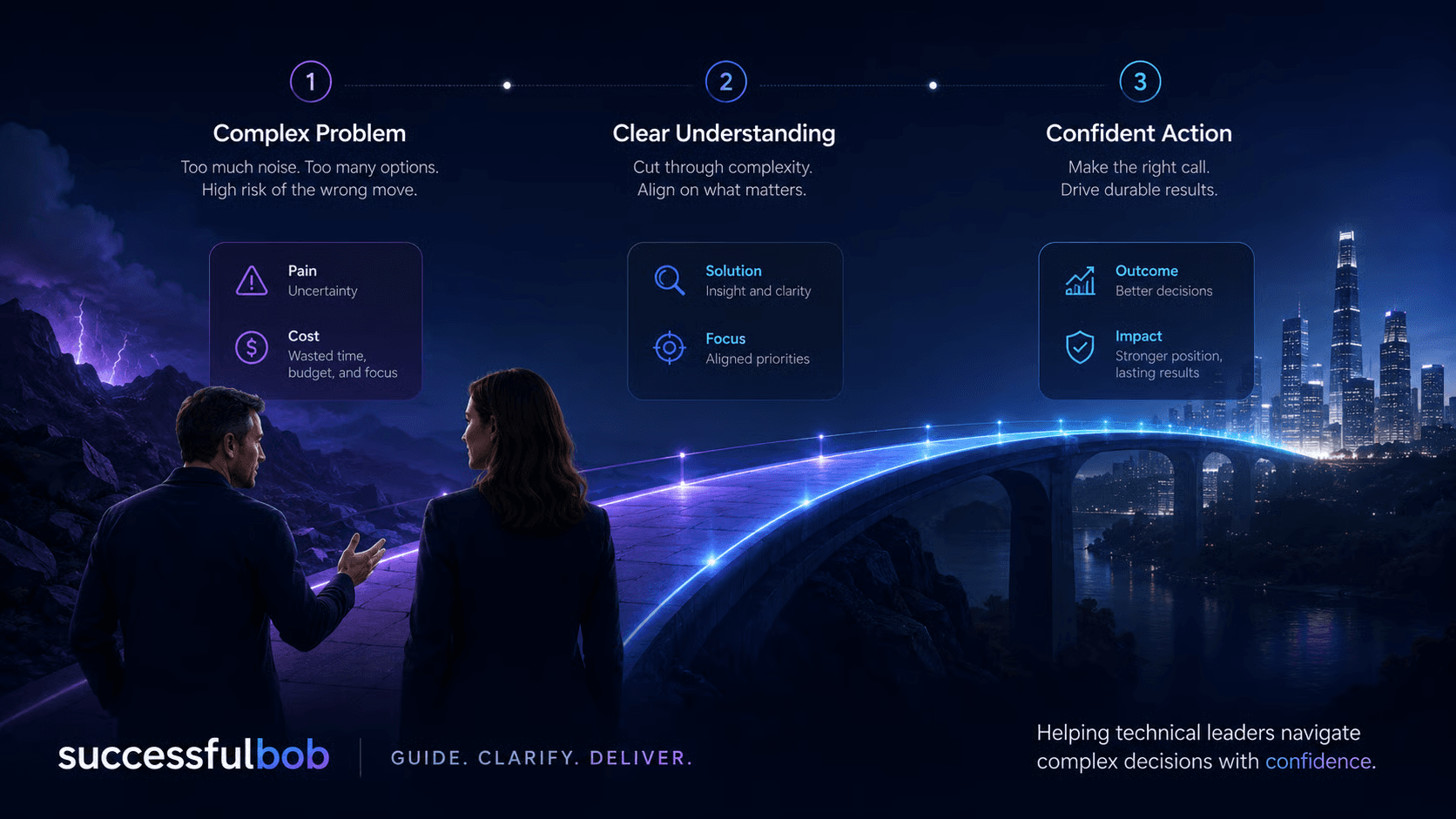
You sell a technical product to buyers who do not know the solution exists by teaching the pain before pitching the product. The buyer needs to understand what problem they are dealing with, what the current workaround costs, why doing nothing is punitive, and why a better way is now possible.
Only then does the product have somewhere to land.
Some technical products do not lose because buyers reject them. They lose because the buyer never knew what to look for.
That is a hard problem for technical companies because the team usually sees the solution before the market does. The founder, product team, and early customers may understand the pain clearly. They may know the workaround is inefficient, risky, expensive, or broken. They may even have paying customers proving the problem is real.
But the broader market may not be searching for the solution yet.
That creates a different kind of GTM problem.
You are not just competing for attention against known alternatives. You are trying to help buyers recognize a problem they may feel every day but have not yet named as something solvable.
That is expensive work.
It is also risky work.
If you educate the market poorly, buyers will not understand why they should care. If you educate the market well but do not attach yourself to the answer, you may pay the education tax while someone else collects the reward.
The order matters:
1.Name the pain in language the buyer already feels.
2.Prove the cost of the current workaround.
3.Show why the old way is no longer good enough.
4.Create belief that a better way is possible.
5.Then explain why your product is the credible path.
Do not start by naming the competitor
When buyers do not know your category exists, one of the first mistakes companies make is talking too much about competitors.
That may feel natural internally. The team wants to define the market, explain the difference, and show why its product is better.
But if the buyer does not know the solution category exists yet, be careful with he who shall not be named.
Any attention is good attention.
If you do the hard work of educating the buyer, do not hand that attention to someone else too early. Do not spend your energy creating curiosity and then send the buyer off to research a competitor they had never heard of before.
The first job is not to explain the competitive landscape.
The first job is to help the buyer recognize the pain.
Once the buyer understands the pain, the cost of doing nothing, and the possibility of a better way, then comparison can be useful. But leading with competitors in an immature market can accidentally make the competitor more memorable than the problem you were trying to teach.
Customer validation tells you the problem is real
There is an important difference between “buyers do not care” and “buyers have not been taught how to recognize the problem.”
Customer validation helps separate the two.
If you have paying customers, the problem is probably real. Someone felt enough pain to pay for a solution. Someone saw the value. Someone believed the change was worth the effort.
That does not automatically mean the broader market is ready.
If you are having trouble filling the top of the funnel, especially through organic channels, you may not have a product-value problem. You may have a solution-awareness problem.
People are not searching for what they do not know exists.
They may search for symptoms. They may search for adjacent tools. They may complain about complexity, wasted time, lost productivity, messy handoffs, or operational risk. But they may not search for your category, your feature set, or your exact product language.
That is a sign the market still needs education.
Some pains are felt before they are named
Complexity is one of the biggest examples.
A buyer may not wake up thinking, “I need a platform to reduce operational complexity across fragmented workflows.”
They may just feel the damage.
Too much time lost switching from tool to tool.
Too much information trapped in messy systems.
Too many people bypassing the official process because the official process is too hard.
Too many decisions made with incomplete context.
Too much productivity disappearing into coordination work.
Too much risk created by people inventing workarounds because the approved path is too slow or confusing.
The buyer feels all of that.
But feeling the pain is not the same as naming the business problem.
And naming the business problem is not the same as believing a better solution exists.
That is why market education matters.
The product pitch needs a landing spot
If you jump straight into the product before educating the buyer, the information has nowhere to land.
The buyer may understand the words.
They may even think the product is impressive.
But they do not yet understand why it matters to them.
They do not know which pain it is supposed to solve. They do not understand the cost of doing nothing. They do not know why the current workaround is expensive. They have no mental model for why this should be a priority.
That is how technical products become “interesting” but not urgent.
The product explanation arrives before the buyer has a place to put it.
Market education creates the landing spot.
It helps the buyer understand:
·what problem they are actually dealing with
·why the current workaround is costing them
·why ignoring it is punitive
·why the problem is now solvable
·why the solution should be considered now
Only then does the product pitch have somewhere to go.
Teaching the market is expensive
There is a reason many companies avoid market education.
It is one of the most expensive and risky things a company can do.
History is full of innovative companies that paid a steep education-based customer acquisition cost, only to watch a copycat competitor enter after the market was educated and split the reward.
That does not mean companies should avoid educating the market.
It means they should do it intentionally.
The goal is not to lecture the buyer. It is not to make the customer feel behind, naive, or wrong.
The better posture is to act as the loyal guide.
Help the champion see the problem clearly. Help them understand the cost. Help them recognize that a better path exists. Then let them be the hero for discovering it inside their company.
That distinction matters.
If you educate the market like a professor, you may get agreement.
If you educate the market like a guide, you may create a champion.
And when you win those customers, keep them close. Once the market starts to understand the problem, competitors will show up. The companies that paid the education tax need to be very good at retaining the customers they helped create.
Put the workaround cost into money
Whenever possible, translate the pain into money.
Money is not the only thing buyers care about, but it is one of the easiest ways for a champion to recruit additional stakeholders.
A champion may personally feel the pain. They may hate the messy process. They may know the workaround is inefficient. But to get legal, finance, operations, security, IT, the executive buyer, or the budget owner involved, they usually need more than frustration.
They need a business case.
The cost can show up in many ways:
·fines or fee avoidance
·reduced downtime
·legitimate risk mitigation
·productivity gains
·efficiency improvement
·competitive advantage
·customer retention
·faster delivery
·fewer escalations
·lower support burden
The point is not to invent fake ROI.
The point is to make the pain easier to explain inside the business.
A good champion needs language they can reuse. If they cannot explain what the problem costs, they will struggle to make the case for why anyone else should care.
Know when the market is immature
Not every company is creating a new category.
A lot of companies think they are doing category creation when they are really just explaining a better way to solve an existing problem.
But there are signs that the market is immature.
If organic demand is weak, if SEO and AEO research show little search volume around the keywords you care about, if buyers are not using the category language, and if you do not have clear competitors, then the market may need to be taught the problem before it can weigh the solution.
That changes the GTM motion.
You cannot rely only on product-led discovery if nobody is searching.
You cannot rely only on category comparisons if the buyer does not know the category.
You cannot rely only on demos if the buyer does not yet believe the problem is costly.
You have to move earlier in the buyer’s thinking.
First teach the pain.
Then teach the cost.
Then show that the old workaround is no longer good enough.
Then introduce the better way.
Then explain why your product is the credible path.
The demo has to show believable pain
When a prospect has not already named the problem, the demo has to do more than show the solution.
It has to show a believable version of the pain.
Not fake pain.
Not infomercial pain where someone somehow destroys half the kitchen trying to pour milk.
Real pain.
The kind of pain the buyer recognizes from their own work.
The demo should show the before and after. What does the world look like without the solution? Where is the lost time, risk, confusion, manual work, delay, or missed opportunity? Then what changes with the solution?
The more specific the contrast, the better.
If you can attach metrics, even better. That could be quantitative: time saved, cost reduced, risk avoided, downtime prevented, handoffs removed. It could also be qualitative: fewer escalations, cleaner decisions, better visibility, less frustration, more confidence.
The buyer needs something to anchor the improvement to.
Otherwise, the demo may look impressive without making the pain feel important.
Proof matters more than theater
If buyers are not solution-aware, proof is especially important.
A polished demo can help, but buyers know demo environments can be duct tape and chicken wire behind the curtain.
Customer case studies, testimonials, white papers, and credible walkthroughs can be more effective because they show that someone else already felt the pain, understood the cost, made the change, and saw improvement.
That gives the buyer a safer mental path.
They are not being asked to believe only the vendor.
They are being shown that a peer had the same problem and did something about it.
That matters when the market is still learning.
Everyone needs the same simple story
When the market is not yet solution-aware, the company cannot afford internal confusion.
Sales, marketing, product, founders, partners, and executives should all be able to explain five things clearly:
1.What the problem is
2.What the problem costs
3.How the solution handles it
4.What the world looks like after
5.Why doing nothing is punitive
That does not mean everyone should use the same exact script.
It means everyone should carry the same value logic.
If the company cannot explain those five things consistently, the buyer will be asked to do too much translation. And in an immature market, the buyer is already doing enough work.
Give the buyer an easy out
There is a useful way to test whether the buyer recognizes the problem without making them feel accused or condescended to.
Give them an easy out.
For example:
“We have found that several customers in your industry lose meaningful revenue to complexity across tools, handoffs, and workarounds. That is not something you deal with though, right?”
That does a few things.
It makes the pain credible by tying it to peers. It introduces the cost without directly criticizing the prospect. It gives them room to disagree. And it often invites them to correct you if the pain is real.
The buyer can say, “Actually, yes, we do deal with that.”
Now the conversation has a place to go.
That is very different from starting with, “You have a complexity problem and we can fix it.”
One opens a door.
The other can sound like a vendor diagnosis before trust has been earned.
Start with product truth
None of this works if the company does not start with product truth.
You cannot teach pain honestly if you do not understand what the product actually solves. You cannot build an executive narrative if the business value is vague. You cannot make a demo credible if the before-and-after story is exaggerated. You cannot educate the market if the company itself is confused about the problem.
The work starts with the truth of the product.
What does it do?
Who does it help?
What pain does it reduce?
What does it not solve?
Where is the proof?
Where is the buyer already feeling the cost?
Once that is clear, the company can build the rest of the story: the market education, the demo, the champion message, the executive narrative, the partner story, and the field motion.
Selling a technical product to a market that does not know the solution exists is hard.
But the answer is not to shout louder about the product.
The answer is to teach the pain clearly, prove the cost, show a better way, and make sure the buyer associates that better way with you.
Need help teaching the market before pitching the product?
Production Ready helps technical companies turn product truth into buyer-ready messaging, demos, executive narrative, partner story, and field repeatability.
If your product is strong but the market does not yet understand the pain, the first step is building the story that gives the solution somewhere to land.
Schedule a 30-minute fit call: https://calendar.app.google/7whsjgVTFPQNQ7oE6