
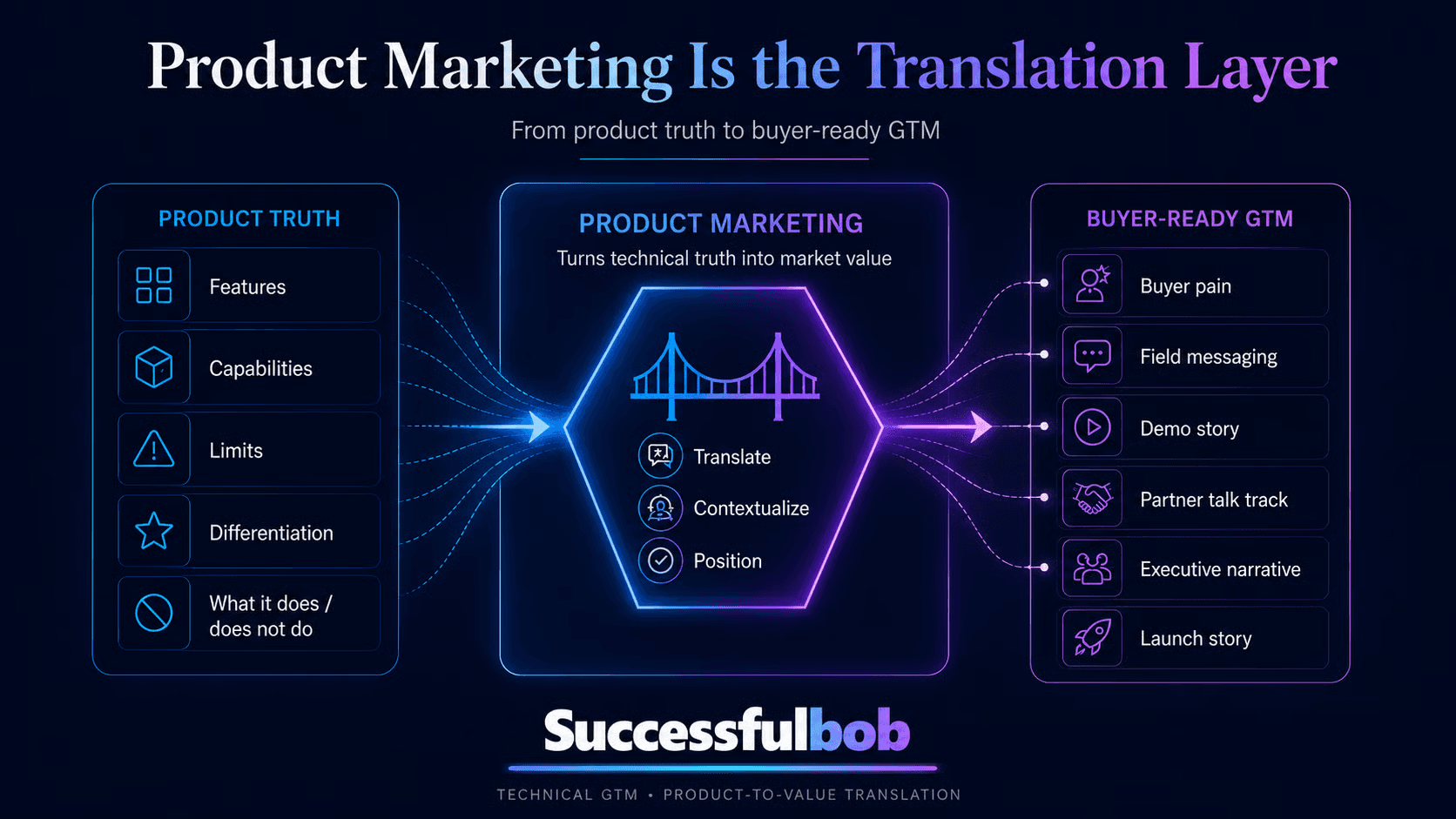
Product marketing in a technical company translates what the product actually does into a clear buyer story the market, sales team, partners, and executives can understand and repeat. It connects product truth to buyer pain, turns features into business value, shapes demos and launches, and helps the field explain why the product matters to the right audience.
That sounds simple, but it is where a lot of technical companies struggle.
They do not have a product problem.
They have a translation problem.
The product may be real. The engineering may be strong. The features may be differentiated. The founder may be able to explain everything beautifully on a sales call.
But when the story has to move beyond the founder, beyond the product team, beyond the first few technical believers, things start to break.
Sales wants better messaging.
Marketing wants clearer positioning.
Partners want a simple reason to care.
Executives want the business case.
Customers want to know what changes for them.
That is where product marketing should matter.
Product marketing is not just making slides
Like a lot of technical roles, product marketing often gets confused with its outputs.
Developers get treated like code monkeys.
Sales engineers get treated like demo jockeys.
Product marketing gets treated like the team that makes launch decks, analyst slides, web copy, one-pagers, and battlecards.
Those things may be part of the job.
They are not the whole job.
A good product marketer in a technical company is part of the marketing team, but they need to understand the product more deeply than a general marketer. They need to understand the “how,” and hopefully the “why,” behind what the product does.
They own the conversion of product truth into useful market-facing deliverables.
But just as importantly, they should understand who cares about those deliverables and why they care.
A slide is not the strategy.
A launch deck is not the positioning.
A one-pager is not the buyer narrative.
Those are outputs of the work.
The real work is understanding the product, understanding the buyer, and creating the translation layer between the two.
Technical PMM sits between product truth and human reality
Product marketing in a technical company needs three things.
It needs to be technical enough to understand the product’s capability and limitations accurately.
It needs to be business-minded enough to understand how the solution interacts with workflows, systems, budgets, risks, and operating models outside the company’s internal vacuum.
And it needs to be human enough to translate both views into a buyer experience that makes sense.
That last part matters.
A technical product does not live in a lab once it hits the market. It lives inside messy organizations with legacy tools, budget constraints, security requirements, procurement processes, skeptical users, competing priorities, and people who already have too much work to do.
Product may define what the feature does.
Engineering may define how it works.
Product marketing has to help explain why anyone should care.
That requires more than knowing the feature list.
It requires understanding the context where the product becomes valuable.
Product marketing needs the firmest foundation of product truth
Technical companies sometimes want product marketing to campaign around every feature that technically exists.
That is dangerous.
Not every capability deserves the same amount of attention.
Some features are core.
Some are differentiators.
Some are required table stakes.
Some exist mostly to round out a checklist.
A donut spare tire is a good example.
Technically, the car has a spare tire.
You can check the box.
But it is not a full-function tire.
It is not meant to be driven like a normal tire.
You would not build the car’s marketing campaign around the spare.
Technical products have plenty of donut spare tire features.
They are real.
They matter in certain situations.
They may even satisfy a requirement.
But they should not become the center of the story.
Good product marketing needs to know the difference.
What does the product actually do?
What does it not do?
What does it technically do, but not in a way that should be oversold?
Where is the product genuinely strong?
Where is it not ready yet?
Which features prove real value?
Which features only help complete the buying checklist?
That is product truth.
Without it, product marketing becomes either vague or dangerous.
Vague messaging fails to create urgency.
Overstated messaging creates trust problems in the field.
Technical buyers can smell the difference.
Product marketing turns function into a buyable narrative
Product teams and developers are often focused on functions, criteria, performance, usability, roadmap, and delivery.
That is necessary.
But it is not the same as a buyable narrative.
A product team might say:
“We can now move a petabyte of data coast to coast in 22 hours.”
That is technically impressive.
But the buyer may still need help understanding why it matters.
Product marketing should be able to translate that into something closer to:
“Keeping up to a petabyte of change data fully synced across the country can help executives support business continuity while keeping operating costs low.”
Now the feature has a business frame.
It connects to continuity.
It connects to cost.
It connects to risk.
It gives a stakeholder a reason to justify the spend.
That is the job.
The technical truth does not disappear.
It gets translated.
The buyer does not need less truth. They need the truth in a form that connects to their world.
Product training is the what and how. Product marketing is the when and why.
Product training and product marketing often overlap, but they are not the same thing.
Product training explains what the product does and how it works.
Product marketing explains when it matters and why someone should care.
Product training might teach a rep how to show a feature.
Product marketing should help the rep understand when to show it, who should see it, what pain it maps to, what business outcome it supports, and how to explain it without turning the conversation into a feature tour.
That difference matters across the entire GTM motion.
Sales needs to know why a prospect should buy.
SEs need to know which demo moments matter to which audiences.
Marketing needs to know which messages create interest.
Partners need to know when to bring the company into a customer conversation.
Executives need to know how the product supports a strategic narrative.
If everyone has to understand exactly how every part of the product works before they can speak about value, the GTM motion will not scale.
Good product marketing helps the GTM team carry the story without requiring every person to become a product expert.
Good technical PMM makes the whole GTM team better
A strong technical product marketer can raise the level of the entire GTM organization.
They help sales tell a cleaner story.
They help SEs make demos more relevant.
They help marketing create content that maps to real buyer pain.
They help partners understand where the product fits.
They help executives explain the business value without getting trapped in technical detail.
They help launches connect to market problems instead of just release activity.
The goal is not to make the GTM team less informed.
The goal is to make the GTM team more effective.
Product marketing should map what the product does and does not do into a clear explanation of why the product matters.
Then reps, marketers, channel managers, executives, and partners can spend more of their energy answering the question that matters most:
Why should this person buy, sell, support, or care about this product?
That is a much better use of GTM energy than forcing every team to rediscover the story for themselves.
Starting late is expensive
It is better to start product marketing late than never.
But technical companies should be careful about waiting too long.
Product marketing is most valuable when it can meet people at their highest point of interest.
Maybe someone just discovered the company.
Maybe they saw the product at a trade show.
Maybe a clever social post made them lean in.
Maybe they heard about the product from a partner.
Maybe a launch created curiosity.
Whenever that interest happens, product marketing should help move the person from attention into action.
That might mean entering the funnel.
It might mean enabling a new stakeholder.
It might mean giving a partner SE enough context to carry the story.
It might mean turning a product announcement into an actual buying conversation.
If product marketing starts too late, the company may still generate attention, but struggle to convert that attention into useful movement.
The market leans in.
The company is not ready with the right story.
That is a painful miss.
Do not expect full clarity in 30 days
Founders and CEOs should be realistic about what strong product marketing can do in the first 30 days.
If every product, feature, advantage, and differentiation can be fully understood in 30 days, the product may not be very technical or differentiated.
Really good technical PMM takes time.
The person has to learn the product.
They have to understand the buyer.
They have to hear the sales conversations.
They have to talk to product and engineering.
They have to understand what is real, what is aspirational, what is table stakes, and what is actually differentiated.
They have to scaffold the nuance together.
This is one of the areas where a more senior skillset can create a high return.
You want someone who has seen things.
Someone who has had the conversations.
Someone who can rely on real human experience, not just templates.
This is not the place to throw bodies at the problem and AI it into oblivion.
AI can help structure, draft, summarize, and scale parts of the work.
But it cannot replace the judgment required to know which technical truth matters, which buyer cares, and how to make that connection credible.
A simple test: pitch the release notes
Here is a practical exercise for any technical company.
Pitch the release notes.
Take the last release cycle.
Look at the bug fixes.
Look at the feature enhancements.
Look at the performance improvements.
Look at the integration updates.
Then ask the product marketing team to sell you on why this was an excellent release cycle.
Not internally.
Not as a list of shipped work.
As buyer value.
What do these fixes mean for different roles?
Which feature enhancements matter to which customers?
What pain did the release reduce?
What risk did it remove?
What workflow did it improve?
What new story can sales tell?
What should customer success mention?
What should partners understand?
What should be ignored because it is technically real but not marketable enough to emphasize?
Good product marketing should be able to convert features and functions into context and value.
That does not mean every release needs a massive campaign.
It means every meaningful product change should be understood through the lens of who cares and why.
Product marketing is the translation layer
Product marketing in a technical company is not just slides, launches, or messaging polish.
It is the translation layer between product truth, buyer pain, and field execution.
It helps the company understand what is real.
It helps the market understand why it matters.
It helps the field explain it.
It helps partners repeat it.
It helps executives justify it.
And when it works, the company stops depending on a few technical heroes to explain the product correctly every time.
That is when GTM starts to scale.
Want help turning product truth into buyer-ready messaging?
Production Ready helps technical companies translate real product depth into buyer-ready messaging, demo flows, field stories, partner enablement, and executive narratives that the GTM team can actually use.
If your product is strong but the story is not carrying clearly through the field, that is fixable.
Schedule a 30-minute fit call: https://calendar.app.google/7whsjgVTFPQNQ7oE6