
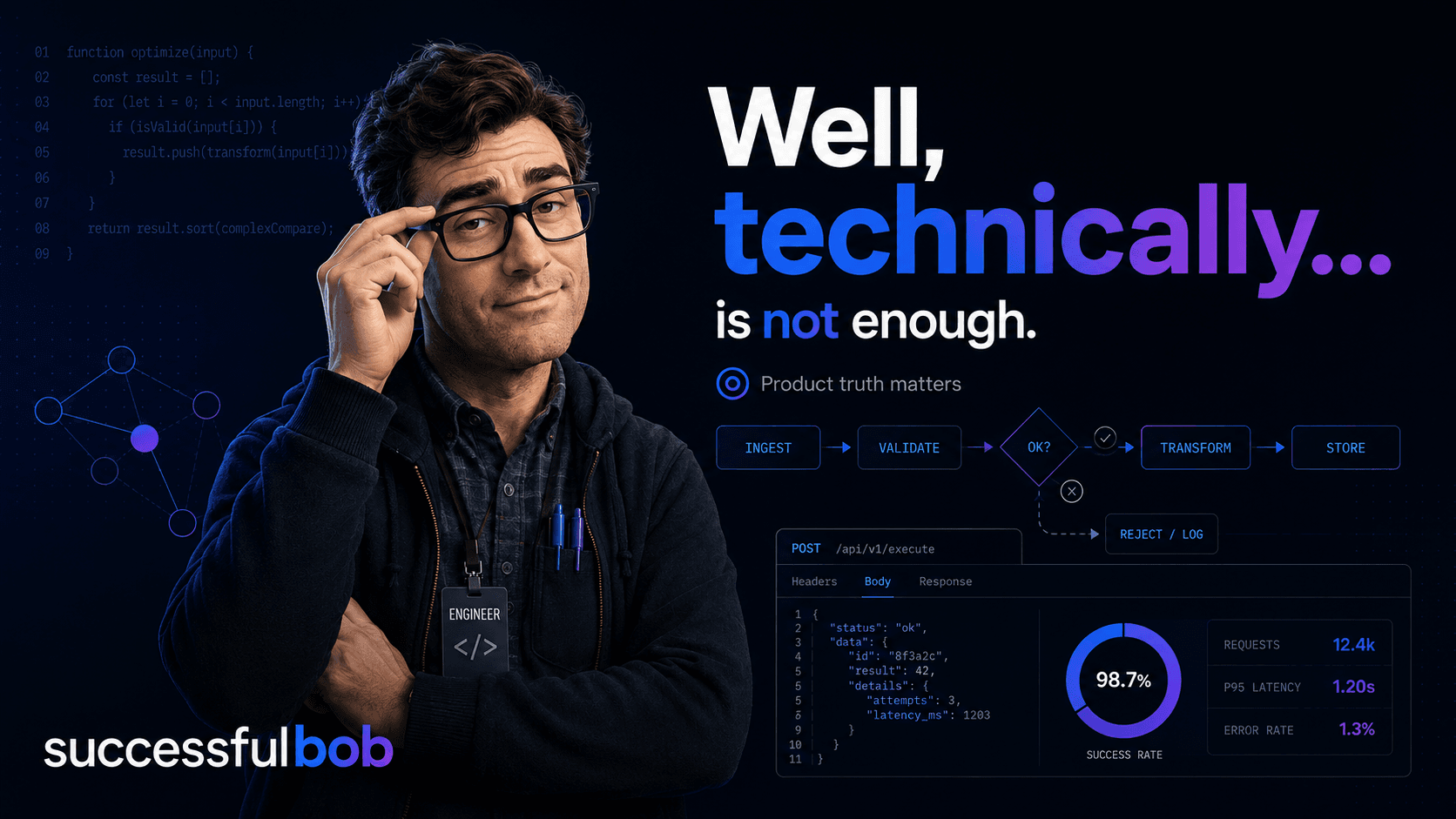
When product, sales, and engineering disagree about what the product can do, product marketing should not average the opinions or pick the loudest team. It should go back to a shared Product Truth: a living, evidence-backed record of what the product can do, cannot do, could potentially do, and could never do, including the boundaries, dependencies, confidence, owner, and last validation behind each claim.
In practice, engineering is usually closest to the technical truth.
Product knows what the product was intended to do.
Sales knows what they want it to do.
Engineering built the thing. They usually know what the code can actually support.
That does not mean engineering always understands the commercial value of what they built. It does mean they are usually the best place to start when the disagreement is about whether something is actually possible.
Disagreement is normal
Think of it like a game of telephone.
Product owns the vision and roadmap.
Engineering builds, updates, revises, patches, extends, and occasionally gets pulled into one-off work to help close a deal.
Sales is trying to fit the product anywhere someone might pay for it.
Over time, those three realities start to separate.
Engineering may have added capabilities that product has not fully incorporated into the broader story yet.
Sales may hear a capability-adjacent term and assume the product does something else that sounds related.
Product may be following the official roadmap and release cycle while all these small adaptations are happening in the field.
Nobody has to be lying for the company to end up with three different versions of reality.
That is exactly why you need a shared source of truth.
The most dangerous version is overpromising
The worst disagreement is the one that makes it all the way to the customer.
At that point, it is no longer just a messaging problem.
It is liability.
You may have promised something the product cannot actually do. You may have represented a capability as supported when it was only technically possible in a narrow scenario. You may have created contractual, financial, reputational, or legal risk.
Not to be that guy in the capitalistic country, but no company, no jobs.
Take care of the entity to take care of the people.
A little caution before making a claim is much cheaper than trying to clean up a bad promise later.
This is why Product Truth needs to be a living catalog
When teams disagree, you need something more authoritative than Slack history, tribal knowledge, or whichever person sounds most confident in the meeting.
You need a Product Truth catalog.
For every important product claim, it should capture:
- what the product can do
- what it cannot do
- what it could potentially do
- what it could never do
- why that statement is true
- what evidence supports it
- what boundaries or limitations apply
- what dependencies exist
- how confident the company is
- when the statement was last validated
- who owns that truth
Everything else should build off that foundation.
Messaging.
Sales guardrails.
Demo flows.
Partner enablement.
Qualification.
Customer expectations.
If the underlying truth changes, those downstream assets should change too.
“Technically possible” is not a product claim
There is always someone in the room who adjusts their glasses and says, “Well, technically...”
That person is probably about to get kicked out of the room.
Technically possible is not the standard.
The first question is whether the feature actually works as intended.
Has it been pressure tested?
Does it work repeatedly?
Does it work at the scale or volume you are promising?
If the answer is yes, then you ask the second question:
Is there commercial viability?
I can technically break thousands of wine glasses a day if you give me a baseball bat.
That does not mean I have discovered a compelling new business model.
If something works reliably and there is a real commercial reason for customers to care, I probably do not need to convince you that it belongs in the market story.
Multiple paying customers are the best evidence
The strongest validation is multiple paying customers successfully using the capability.
That gives you several kinds of evidence at once:
- it works
- it is repeatable
- someone values it enough to pay for it
- the value can be reproduced outside your internal environment
That is about as close to a gold standard as you can get.
After that, look for evidence that the capability succeeds under realistic scale, volume, stress, and operating conditions.
Treat it like the scientific method.
A single successful demo is interesting.
A one-off custom build is interesting.
An engineer getting it to work once at 11:30 PM is interesting.
None of those automatically mean you should market it as a reliable product capability.
Conditional truths need to stay conditional
Sometimes the right answer really is:
“Yes, but only if...”
That is fine.
The problem starts when marketing removes everything after the “but.”
If the capability requires a specific external driver, module, integration, customer environment, service, or third-party vendor, say so.
This becomes especially important with external dependencies.
If another vendor is required for your capability to work and that vendor changes its product, stops supporting an integration, or disappears entirely, your own claim may no longer be true.
That is not a footnote.
That is part of the Product Truth.
You can still sell the upside
None of this means technical product marketing needs to become painfully conservative.
I actually like flirting in the gray area.
The trick is making the boundary visible.
In a demo, I might show the smallest function I know is rock-solid and fully supported.
Then I can show how variables, filters, or additional controls could extend that capability and say something like:
This could be used to create incredibly powerful results, depending on how complicated you wanted to get with the controls.
Now I have done two things.
I showed the buyer the safe selling area.
And I showed them the upside without pretending that every possible extension carries the same level of support, testing, or certainty.
That is a much better way to communicate possibility than quietly turning “could” into “does.”
Escalate when the disagreement creates real risk
Not every disagreement needs an executive meeting.
If product and engineering disagree about wording in an internal document, work it out.
If sales wants a slightly broader claim and engineering wants a slightly narrower one, pressure-test the evidence.
But once the disagreement creates meaningful financial, legal, or reputational risk, leadership needs to be involved.
That is where Product Truth stops being a messaging exercise and becomes a governance issue.
The question becomes:
What can this company responsibly and defensibly claim?
That matters a lot more than whether a sentence sounds better on the website.
Product Truth comes first
Once the disagreement is resolved, the first artifact that should change is the Product Truth.
Not the sales deck.
Not the demo.
Not the website.
Not the partner training.
Update the underlying truth first.
Then let everything downstream inherit from it.
That is the whole point.
If your teams disagree about what the product can do, you do not have a messaging problem yet.
You have a source-of-truth problem.
Fix that first.