
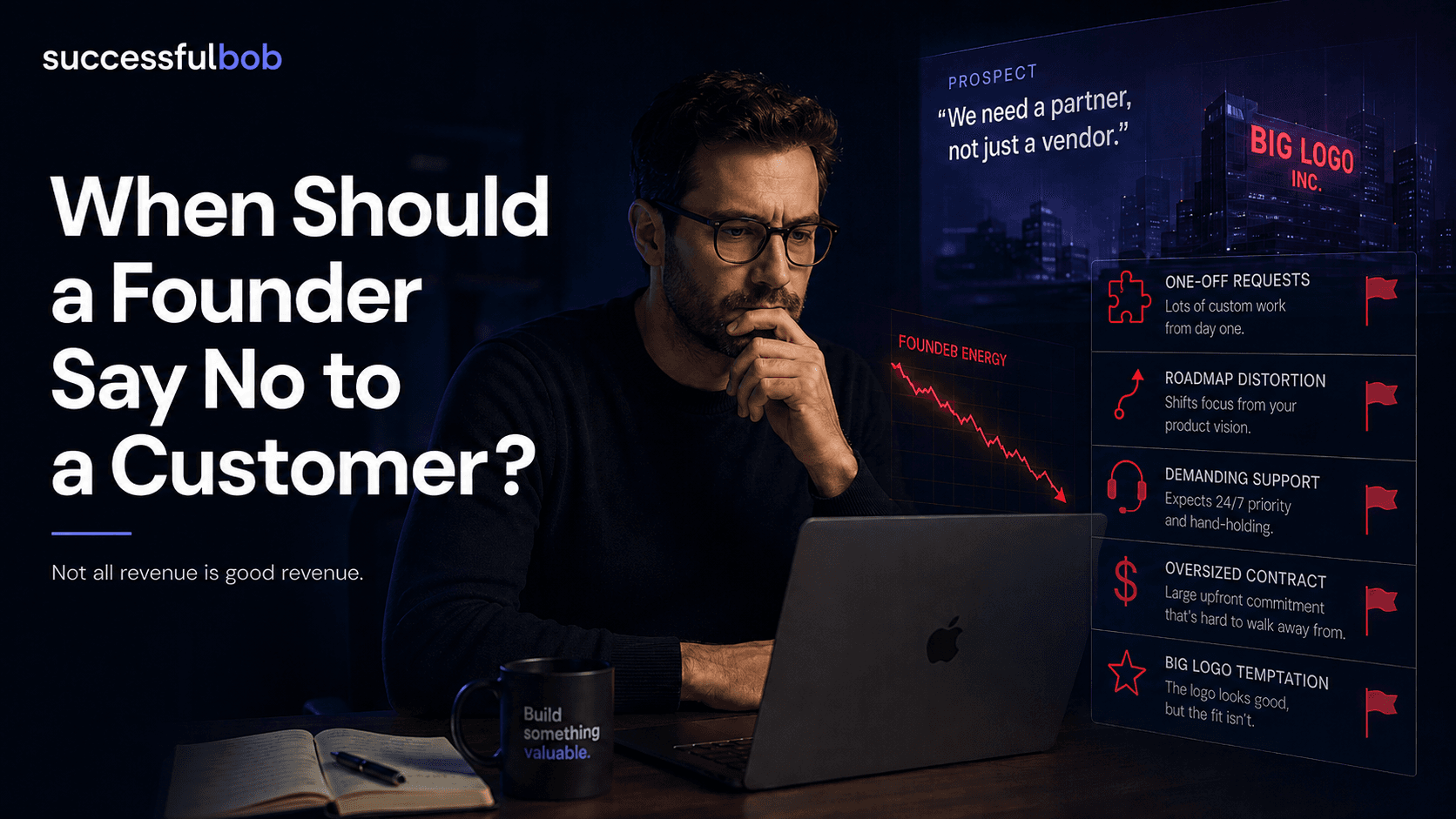
A founder should say no to a customer when winning the deal requires the company to become something it does not actually want, know how, or intend to be.
That sounds easy when you have plenty of revenue, a healthy pipeline, and twelve months of runway.
It is considerably harder when the logo would look great on your website, the contract could solve this quarter’s cash problem, or the prospect is dangling the magical phrase: “We’ll buy if you just add this.”
Early companies are supposed to be flexible. They are supposed to listen to customers. They are supposed to move quickly.
All of that is true.
It is also how companies talk themselves into some terrible deals.
The worst losses are sometimes the deals you win
A big customer brings more than revenue.
They may bring credibility. They may become a reference account. Their logo could make the next ten conversations easier. A large contract may solve the exact financial problem keeping the founder awake tonight.
That makes it very easy to focus on the value of winning the customer and considerably harder to calculate the cost of having them.
That cost can be enormous.
A demanding customer can consume engineering time, overwhelm support, monopolize executive attention, distort the product roadmap, and pull resources away from the broader customer base.
The bigger the contract, the more power that customer tends to have.
Nobody wants to lose the flagship account.
So another request gets prioritized. Then another. Support gets an exception. Product changes the roadmap. An executive gets pulled into the weekly customer call because things are getting tense.
Six months later, the company may still have the revenue, but it has also spent two quarters accommodating one account.
For a large company, that may simply be an expensive mistake.
For a young company, it can be fatal.
If you calculated the true total cost of ownership of some customers, including engineering, implementation, sales commission, executive involvement, ongoing support, and the opportunity cost of everything you stopped doing for everybody else, you might discover that the impressive contract was never particularly profitable.
There is a difference between learning and servitude
This does not mean startups should reject anything that requires extra work.
Some ugly work is incredibly valuable.
Do the configuration.
Build the integration.
Work through the bespoke implementation.
Those experiences show you where the product is weak, what customers do not understand, what should be automated, what needs better documentation, and which missing capabilities are legitimate product gaps.
That is customer collaboration.
The problem starts when the customer is asking for custom work simply because they know you desperately want the sale.
Now you are not learning together. You are being held hostage by a purchase order.
There is a judgment call here, and founders need to get good at making it.
The question is not simply, “Does this customer require work?”
The better question is, “Will doing this work make us better at serving the market we actually want?”
If yes, the pain may be worthwhile.
If no, you may be signing up for indentured servitude with an annual contract value attached to it.
The roadmap is one of the best filters
One of the clearest signs that a customer request is healthy is that it points in a direction you were already moving.
Maybe the capability is already on the roadmap.
Maybe several existing customers have asked for it.
Maybe multiple deals have stalled because of the same limitation.
Maybe implementing it would make the product meaningfully stronger for the customers you already want.
That is very different from a prospect asking you to bolt something onto the product because a competitor has it.
Or because AI is hot.
Or because somebody saw a new shiny thing at a conference.
Or because one executive at one company has a highly specific workflow that nobody else has ever requested.
When several customers independently identify the same blocker, pay attention.
When one customer wants you to redesign the company around them, be considerably more skeptical.
Just because your product can do something does not mean you should sell it that way
Imagine the United States government is choosing its next major defense contractor.
Nobody is proposing OfficeMate International because MacGyver once proved you could accomplish remarkable things with a few paperclips and some chewing gum.
Technical possibility is not the same thing as sensible procurement.
Products work the same way.
A technically talented team can often make its product do extraordinary things. Give engineers enough time, integrations, scripts, configuration, professional services, duct tape, and determination, and the answer to “Can it do this?” becomes yes surprisingly often.
That does not mean you should sell it that way.
When a company badly needs a win, it becomes tempting to let a customer square-peg-round-hole the product.
You immediately reach for the file and start knocking down the corners.
Now you have a deal.
You may also have created an implementation nobody else understands, a support obligation nobody planned for, and a product promise sales will accidentally repeat to the next prospect.
The better question is not whether the product can technically accomplish what the customer wants.
It is whether that use of the product is repeatable, defensible, supportable, and commercially sensible.
That is a Product Truth question, not merely an engineering question.
Desperation produces very convincing arguments
The dangerous part is that founders rarely walk into these deals completely unaware of the risk.
Usually they can see it.
They just build an argument for why it will probably work out.
“We can use the revenue to hire more engineers.”
That sounds reasonable until you remember that the engineers you have not hired yet will need to be recruited, onboarded, and brought up to speed.
The customer will not patiently wait while that happens.
Particularly if the customer was demanding enough to create the problem in the first place.
Another favorite is:
“We’re young and scrappy. We’ll handle this one, then land a few more whales before it becomes a problem.”
You probably will not.
The wave from the first whale often hits before the ink is dry on the PO.
Support tickets arrive. Integration questions start. Executives want meetings. Product wants clarification. Engineering needs priorities changed.
The revenue may be arriving over twelve months.
The disruption can arrive Tuesday morning.
Ask whether you would want ten more
Before accepting a questionable deal, I would ask three things.
First: Does this customer look like your ICP?
Not “Are they willing to give us money?”
Are they actually the kind of customer you are building the business to serve?
Second: Are they planning to use the product in a way that aligns with what you know to be true about the product?
If your documented Product Truth says the product works well under certain conditions, for certain use cases, with known boundaries, the customer should generally fit inside those boundaries.
A giant contract does not magically make those constraints disappear.
Third: Does the deal still make financial sense once you include the real cost of supporting it?
Founders are usually pretty good at looking at revenue.
They are not always as disciplined about allocating the costs underneath it.
Engineering R&D.
Implementation.
Sales commission.
Support.
Infrastructure.
Executive attention.
Customer success.
And especially ongoing support.
Support can be a revenue department. In a subscription business, good support protects renewals, reduces churn, and expands accounts.
Or support can hemorrhage money while your team provides 24/7 life support to a lemon account.
Those are very different economics.
A useful additional test is simple:
Would you be happy if ten more customers exactly like this one showed up tomorrow?
If that thought makes you physically uncomfortable, the current customer probably deserves another look.
What if you only have three months of runway?
This is where the conversation stops being theoretical.
Suppose you have three months of runway and a $100,000 deal in front of you.
It is a bad fit.
Do you take it?
My answer is still probably no.
Three months of runway is uncomfortable. Very uncomfortable.
But adding a bad customer does not necessarily make the company safer.
You may simply be trying to stay afloat while adding more weight to the boat.
Now you need additional staff to support the account, or you redirect the staff you already have. Product priorities change. Engineering priorities change. Leadership attention changes.
You have extended your runway in exchange for gambling part of your future.
There is a point where the calculation changes.
If you are not going to make the next payroll, you may have to gamble.
Survival matters.
But three months is not the same thing as missing payroll Friday.
There is still time to sell the right thing, change the plan, cut costs, raise money, or make other difficult choices without knowingly signing the company up for a customer relationship that could make the underlying problem worse.
Founders should absolutely listen to customers.
They should stretch.
They should occasionally do things that do not scale because those experiences teach them what eventually should.
But flexibility is not the same thing as surrender.
Sometimes the most important sale a founder makes is the one they are willing to walk away from.