
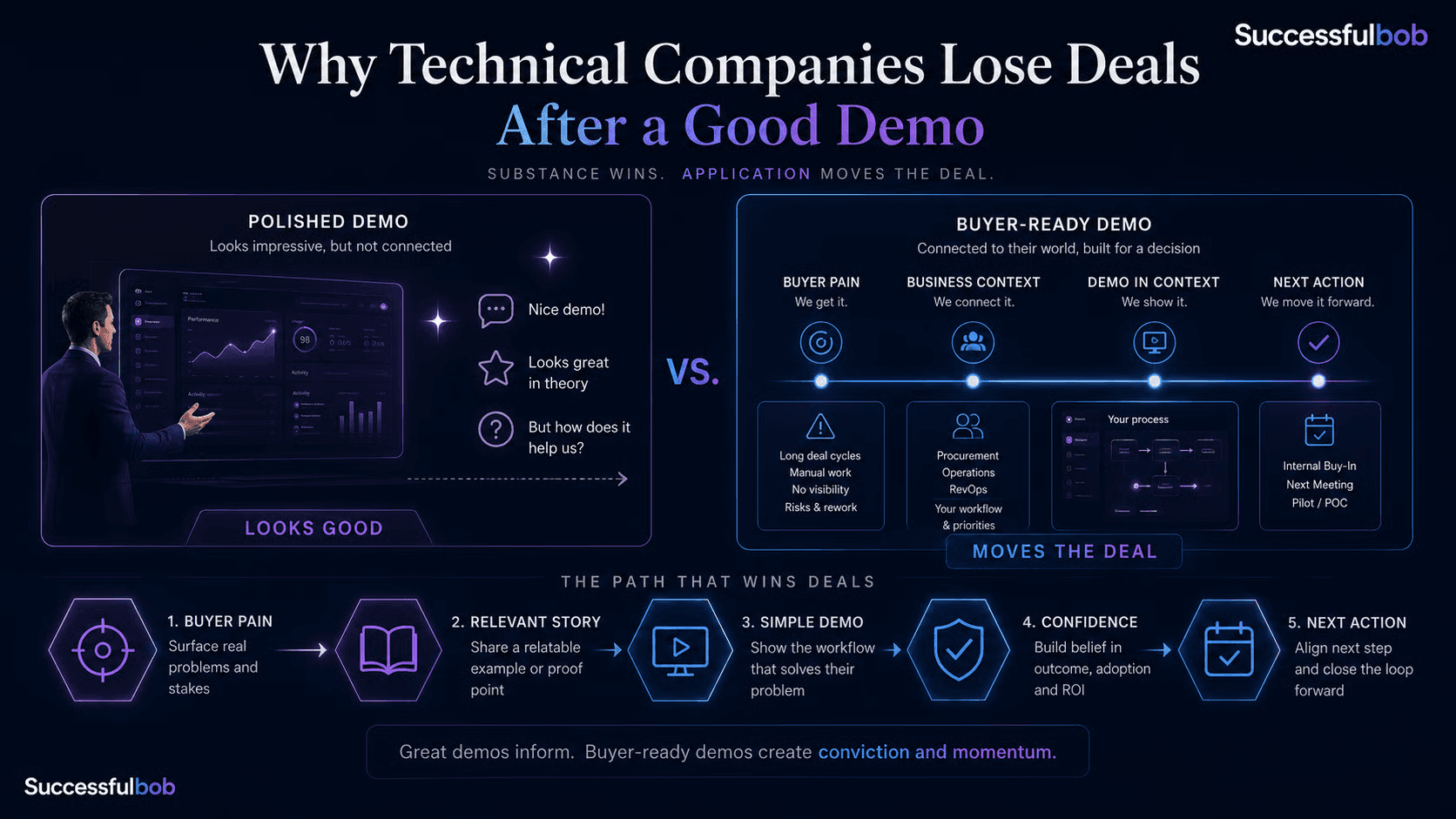
Technical companies lose deals after a good demo because they show the product well, but they do not always address the buyer’s actual needs well. The demo may be polished, impressive, and technically accurate, but if it does not connect to the buyer’s pain, urgency, environment, and decision process, it can create interest without creating movement.
That is one of the strangest problems in technical sales. Everyone leaves the meeting feeling like the demo went well. The product looked good. The audience nodded. The technical team handled the questions. Nobody embarrassed themselves. Maybe someone even said, “This is really cool.”
Then nothing happens.
The deal slows down. The follow-up gets vague. The buyer says they need to “circle back internally.” The champion loses energy. The next meeting never gets scheduled. The demo was good, but the opportunity did not move.
That usually means the demo was product-ready, but not buyer-ready.
A good demo can still miss the point
A lot of technical demos are built to show capability.
They prove that the product works. They show the workflow, the interface, the architecture, the speed, the automation, the integrations, the reporting, the controls, or the technical elegance.
All of that can matter.
But a buyer is not only asking, “Does this work?”
They are also asking, “Does this matter to me?”
That second question is where many demos fail.
The demo may show something impressive, but the buyer may not have the pain that makes it urgent. The demo may prove a powerful technical capability, but not connect that capability to the buyer’s current situation. The demo may be clean and polished, but still feel like something happening to someone else.
That is the difference between showing the product and showing the buyer their own future.
Instagram ready is not the same as Reddit ready
Some demos are Instagram ready.
They are polished. They are clean. They show well. They make the product look impressive in a controlled environment.
But buyers live in Reddit reality.
Their environment is messy. Their priorities are inconsistent. Their internal politics are weird. Their constraints are specific. Their existing systems have scars. Their pain may not match the vendor’s favorite demo path.
A demo can look great and still not be grounded enough.
That is why the best technical demo is not always the most visually impressive one. It is the one that makes the buyer think, “Yes, that is us. That is our problem. That is what we need to fix.”
If the buyer cannot see themselves in the demo, the demo becomes a product tour with better lighting.
The demo has to match the pain
I once worked on a distributed file system where the demo showed extremely well.
We could show someone opening and editing the same file quickly from geographically different places. It was easy to explain the impact for business continuity, disaster recovery, backup and recovery, and collaboration workflows. The technical capability was real, and in the right environment, the value was obvious.
But that did not mean the same demo mattered equally to every buyer.
If the company had three locations all within 20 milliseconds of latency from each other, the pain was not the same. They were not struggling with the kind of geographic distance problem the demo was built to dramatize. The product could still be valuable, but the standard demo did not automatically create urgency for that audience.
In that situation, the better move was not to push harder through the same demo. The better move was to find the pain that actually mattered to them.
Maybe they wanted to close one of the locations and move more infrastructure into the cloud. Maybe they were planning to expand into another geography. Maybe they had a recovery objective they could not meet with their current setup. Maybe they had collaboration workflows that were starting to break as the company changed.
Or, sure, maybe we needed to raise the terrifying possibility of the ever-looming ominous meteor that could take out every location within 20 milliseconds of each other.
That one may not make the business case deck.
But the point holds.
The technical capability only matters when it connects to a pain, advantage, or change the buyer actually cares about.
The demo should feel bespoke, not random
A strong technical demo does not need to be custom-built from scratch every time. That is not realistic, and it is usually not scalable.
But it should feel like it was chosen for the people in the room.
The buyer should feel like the path through the product reflects their world. Their environment. Their pressure. Their constraints. Their opportunity.
That does not mean every click has to be personalized. It means the demo has to be framed around the right story.
Here is the current state.
Here is the pain or risk inside that current state.
Here is where the old way starts to fail.
Here is what changes when the product is in place.
Here is the technical capability that makes that change possible.
That is very different from opening the product and walking through features.
A product tour says, “Here is what we built.”
A buyer-ready demo says, “Here is how your world changes if this works.”
Simple, clean, focused
Technical demos often become too complicated because the team wants to show everything the product can do.
That instinct is understandable. A lot of work went into the product. Different stakeholders may care about different pieces. The team wants to show depth, credibility, and future value.
But too much detail can work against the demo.
If the audience is trying to understand the basic story while also tracking every feature, workflow, setting, exception, and edge case, the product starts to feel harder to adopt than it really is.
A good demo should make the audience believe they could see themselves using the product.
That means the core path has to be simple, clean, and focused. Show the technical capability delivering on the pain or advantage the buyer needs, without making the product look so complicated that the audience mentally disqualifies themselves.
You can leave threads for future value. You can point to deeper capabilities that matter to other stakeholders. You can say, “There is more here for the security team,” or “This is where operations usually wants to go deeper,” or “For the executive sponsor, the important part is the risk reduction.”
But those threads should not take over the main story.
The main story has to land.
A demo is a day-in-the-life story
The best demos often feel less like a product walkthrough and more like a day-in-the-life story.
They show the buyer a realistic moment.
Something breaks.
Something takes too long.
Someone cannot see what they need.
A team is stuck waiting.
A process depends on manual coordination.
A risk is invisible until it becomes expensive.
A customer, employee, partner, or executive is frustrated.
Then the product enters the story and changes what happens next.
That is the part the buyer needs to feel.
Not in a fake demo way where the environment is perfectly clean, the data is magically complete, every integration works, and the customer’s business process looks like it was assembled by a product marketer with unlimited coffee.
In a believable way.
A way that makes the buyer think, “Yes, that is exactly the kind of thing we deal with.”
Once they recognize themselves, the technical details have somewhere to land.
Without that recognition, even a strong demo can feel abstract.
Technical proof comes after buyer recognition
Technical teams often think the demo has to lead with proof.
They want to prove speed. Prove scale. Prove security. Prove architecture. Prove integration. Prove automation. Prove that the product is not vapor.
That proof matters.
But proof is most powerful after the buyer understands what the proof is for.
If the buyer does not feel the pain, the proof becomes interesting trivia. If the buyer does feel the pain, the same proof becomes evidence.
That is a huge difference.
A latency improvement is a technical claim. A latency improvement that makes a remote file behave like a local file for a team trying to work across geographies is a business story.
An integration is a feature. An integration that removes two weeks of engineering work from every customer onboarding is a business story.
A dashboard is a screen. A dashboard that shows leadership a risk before it becomes a board-level problem is a business story.
The product did not change.
The context changed.
The SE leader owns the bridge
This is where sales engineering leadership matters.
The SE leader is often the person closest to the gap between technical capability and buyer understanding. They can see when the product is being shown accurately but not usefully. They can see when the demo is impressive to the vendor but disconnected from the buyer. They can see when the team is answering questions well but not moving the opportunity forward.
That makes the SE leader critical to demo strategy.
Not just demo execution. Demo strategy.
The job is not only to make sure the demo environment works and the team knows the clicks. The job is to make sure the demo is aligned to the buyer’s world.
What pain are we proving against?
What does this audience already believe?
What do they still need to believe?
What should they be able to repeat after the meeting?
Which technical details create confidence, and which ones create confusion?
What is the one story this demo has to make obvious?
If the SE leader can answer those questions, the demo gets much stronger.
If not, the demo may still look good, but it is running without a clear buyer argument.
The demo has to survive the meeting
A demo does not end when the screen share stops.
It has to survive the buyer’s internal conversation.
That is why the demo cannot only impress the people in the room. It has to give them language they can use afterward.
If a champion leaves the meeting and says, “The demo was really slick,” that is nice, but weak.
If they can say, “This would let us close the Dallas office without breaking file access for the engineering team,” that is much stronger.
If they can say, “This would cut the onboarding integration burden from weeks to days,” stronger.
If they can say, “This gives us a credible recovery path without rebuilding our whole infrastructure,” stronger.
A good demo gives the buyer a story they can carry.
A bad demo gives them a memory of screens.
Why good demos lose
Good demos lose when they create admiration instead of action.
The buyer may admire the product. They may respect the engineering. They may believe the capability is real. They may even like the team.
But admiration is not the same as urgency.
Urgency comes from relevance. It comes from the buyer seeing their own pain, risk, opportunity, timeline, or internal pressure in the story.
That is why the question after a demo should not be, “Did we show the product well?”
The better question is:
“Did we show why this product matters to this buyer right now?”
If the answer is no, the demo may have been good, but the deal is still fragile.
Build the demo around the buyer’s world
The fix is not to make every demo longer, fancier, or more customized.
The fix is to make the demo more specific.
Start by understanding the buyer’s current state. Then choose the demo path that makes the right pain visible. Cut anything that does not support that story. Keep the product simple enough that the audience can see themselves using it. Use technical depth where it creates confidence, not where it distracts from the point.
A strong demo should feel like a realistic version of the buyer’s life with the product in it.
Not a generic product tour.
Not a feature parade.
Not a performance.
A story the buyer can recognize.
That is how a technical demo moves from “that was cool” to “we need to talk about this internally.”
And that is the difference between a demo that shows well and a demo that sells.
Need a better technical demo story?
If your technical demos are getting interest but not movement, the problem may not be the product. It may be that the demo is showing capability before it has made the buyer care.
Production Ready helps technical companies turn product depth into buyer-ready messaging, demo flow, field narrative, and executive story.
If your team needs to make the demo more specific, more repeatable, and more tied to the buyer’s real decision, you can learn more at successfulbob.com.