
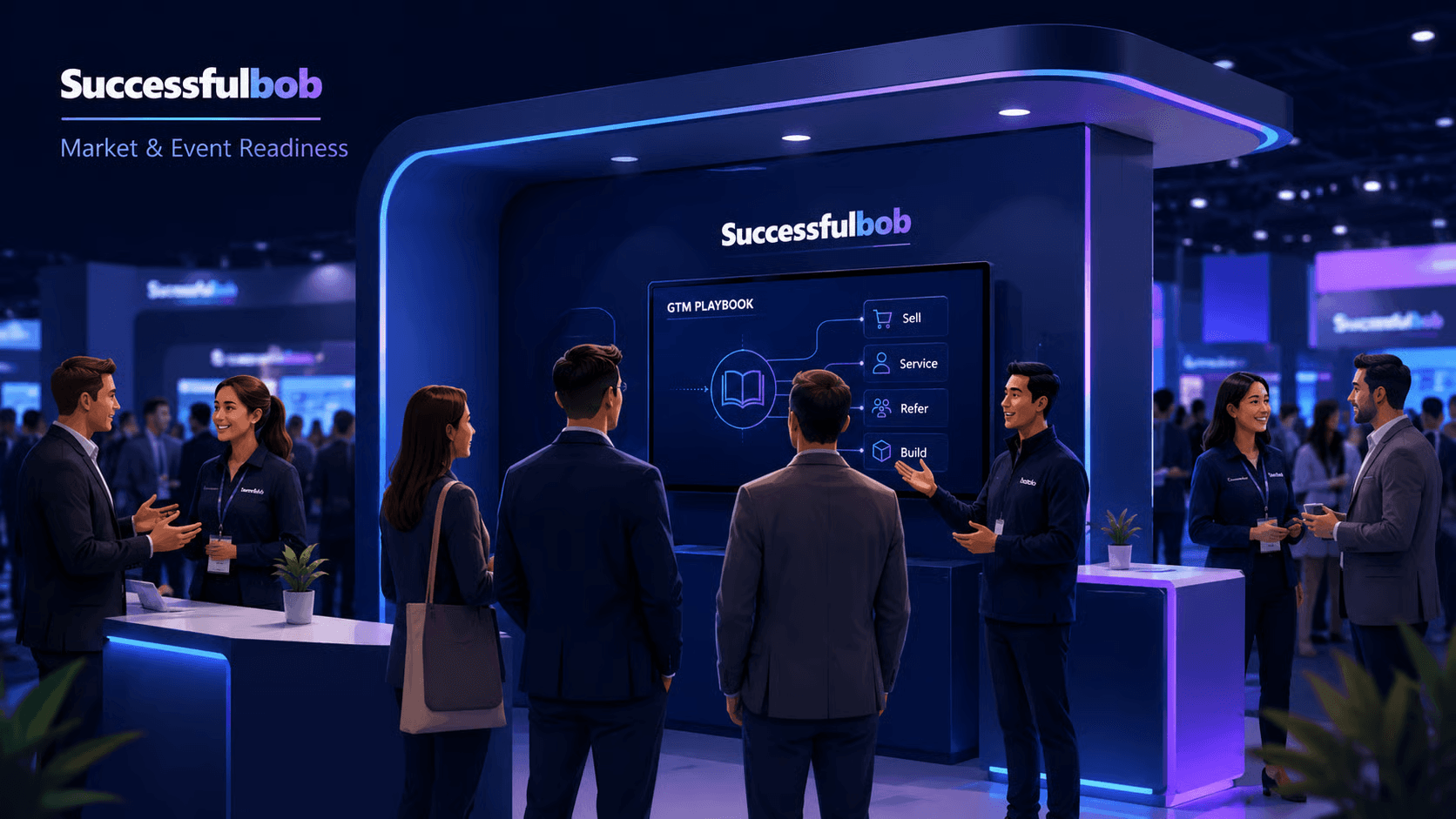
Technical companies waste money on trade shows because they often buy presence before they are ready to make that presence useful. Early on, they need name recognition, market awareness, and mindshare, and unfortunately that often has to be bought. But if the company has not figured out who it needs to talk to, why those people should care, what story the booth team should tell, and how follow-up will happen, the event spend can turn into a very expensive visibility exercise with very little return.
Trade shows are not cheap.
Booth space is expensive.
Travel is expensive.
Sponsorships are expensive.
Swag is expensive.
Happy hours are expensive.
Pulling people out of the field for several days is expensive.
And yet, for a technical company trying to break into a market, there is a real reason to show up.
At the beginning, no one knows who you are.
You need name recognition.
You need mind space.
You need people in the ecosystem to believe you belong in the room.
Sometimes the first move is not pure pipeline. Sometimes the first move is market validation. Do people see you? Do they think you belong in this space? Do they understand why you exist?
That part is real.
The waste happens when companies pay for the room before they are ready to work the room.
Buying presence is not the same as being ready
A lot of event planning starts with aesthetics and presence.
Can we get a 10x20 booth?
What about a 20x20?
Will that give us more status?
Should we pay for better graphics?
What premium swag will get people to stop?
Do we need stuffed animals?
Shirts?
A sponsored happy hour?
A bigger sign?
A better booth build?
None of those things are automatically wrong.
A good booth can help.
Good design can attract attention.
Good swag can create a positive interaction.
But aesthetics are not strategy.
The expensive version of being unclear is still unclear.
One of the roughest event mistakes is spending heavily on a happy hour with a minimum commit, then realizing no one comes because you do not yet have loyal customers, a strong enough draw, or a venue that can compete with the better-known companies.
Another is sending the wrong staff.
That can be a lot of travel expense, salary, and opportunity cost tied up in people who either do not know the product, do not know the audience, or do not know how to qualify a conversation.
The booth looks good.
The team shows up.
The market still does not understand why it should care.
Different teams define success differently
Part of the challenge is that everyone has a slightly different reason for being at the show.
Marketing may be measured on leads, meetings, booth traffic, badge scans, or awareness.
Revenue teams care about opportunities.
Partners may care that their customers and sales teams have at least heard your name before.
Founders and CEOs may care about public perception, category credibility, and whether the company looks like it belongs.
None of those goals are invalid.
The mistake is pretending they are all the same goal.
If marketing thinks the event was a success because the badge scanner was busy, but sales thinks it failed because nothing converted, that is not just a post-event reporting issue. That is an event readiness issue.
Before spending serious money, the company should know what type of return it is trying to create.
Are we buying recognition?
Are we validating messaging?
Are we meeting existing accounts?
Are we creating new pipeline?
Are we strengthening partner relationships?
Are we trying to get executives into a room?
Are we trying to prove we belong in this category?
Different goals require different preparation.
The fundamental question is still: why does this person care?
Every event conversation comes back to the same basic question:
Why does this person care?
If you have not figured out how to answer that for a variety of prospects, you are probably not ready to spend tens or hundreds of thousands of dollars on an event.
At that point, you might as well light the budget on fire and enjoy a festive company currency conflagration as a morale booster.
That would at least be memorable.
The booth team needs to know who they are speaking to and what that person may care about.
The story for a CIO is different from the story for a practitioner.
The story for a partner is different from the story for an analyst.
The story for an existing customer is different from the story for someone who has never heard of you.
If the team cannot make that adjustment live, the event becomes a generic pitch delivered repeatedly to people with very different reasons for stopping by.
That is where money starts leaking.
Every booth conversation has two possible jobs
Not every person who walks up to the booth is a qualified buyer.
That is fine.
A booth interaction can still create value.
There are really two targets.
The first is investing time in someone who may have real interest in your solution. That usually means educating them on how you solve a relevant pain and quickly helping them see why the product might matter.
The second is creating a positive market interaction with someone who is not a buyer, not your ICP, and maybe not even close. Smile, be kind, share the swag, and hopefully they say something nice about you at lunch.
Both have value.
They are not the same value.
The real skill is identifying the difference quickly.
Spend your swag tax quickly.
Spend your talking time carefully.
Have everyone like you.
But make sure the right people understand you.
Those are two different targets.
A good booth conversation is fast and specific
A good booth conversation does not start with a five-minute company history.
It starts with identification and relevance.
Who am I talking to?
What type of company are they from?
What role do they play?
What pain might they have?
What would make them care?
In 60 to 90 seconds, the person working the booth should be able to connect the product to a likely reason that person stopped, or gracefully move on if there is no real fit.
That does not mean being rude.
It means being useful.
A strong booth team should be able to say, in effect:
“Given who you are and what your company does, here is the reason this might matter to you.”
That is much better than:
“Let me tell you everything our platform does.”
The goal is not to impress everyone.
The goal is to quickly create the right conversation with the right person.
Trade show demos need to be short
A trade show demo is not a normal sales demo.
It may use the same core story, but it has to move faster.
In two to five minutes, you should be able to show that the product is not vaporware and that it credibly validates one pain point the person cares about.
That is enough.
Show the product is real.
Show the workflow makes sense.
Show the pain connection.
Show a hint of adjacent value.
Then earn the ask for a follow-up conversation outside the conference.
The booth demo should not try to close the whole deal.
It should create enough confidence and curiosity that the buyer agrees the next conversation is worth their time.
If the demo is too long, too generic, or too feature-heavy, it burns the limited attention you paid so much money to get.
Follow-up is where event ROI usually dies
It is always nice to have a friendly conversation with someone at a booth.
Not $50,000 nice.
But nice.
The event only becomes valuable if the right follow-up happens.
Fresh is best.
Personal is ideal.
Adding someone to a generic email campaign after a meaningful booth conversation is usually a wasted investment.
If the person showed real interest, the follow-up should feel like a continuation of the conversation, not a cold nurture sequence.
Ideally, an AE, SDR, or similar role is working with the booth team and setting follow-up meetings during the event itself.
Not someday.
Not “we will reach out.”
Actually booking the next step while the conversation is fresh.
Then the buyer gets to continue the conversation with a familiar face, and the company has a much better chance of turning interest into a real opportunity.
Handing leads to an AE who does not actually call is sales malpractice.
Go directly to jail.
Do not collect $200.
Partners can make events much stronger
Partners can be incredibly useful at events if you use them well.
One of my favorite motions is a VIP dinner at a conference with a partner involved as a speaker or co-host.
That does a few things.
It builds credibility.
It splits the burden of filling the room.
It gives the event a stronger reason to exist.
It creates partner relationship equity.
It lets the conversation happen somewhere better than a noisy booth aisle.
Partners can also help drive the right people to the booth, validate the story, bring context on target accounts, and create warm paths into conversations that would otherwise be hard to earn.
But the same rule applies.
Partners need to understand the story.
They need to know who should be in the room.
They need to know why those people should care.
They need to know what the joint value is.
A partner logo on an event plan is not the same as a partner motion.
Event ROI should be creative and intentional
Pipeline is usually the easiest ROI story to communicate.
But it is not the only useful return.
For product marketing, an event can be a live test of messaging. Are people leaning in, or are their eyes glazing over?
For design and brand, the booth can test whether your message and visuals actually attract the right audience.
For sales and SE teams, the event can test whether the demo is landing, which pains get traction, and whether people want a follow-up meeting.
For partner teams, the event can test which partners can bring the right people into the room and which ones only look good in a spreadsheet.
For founders, the event can test whether the market believes the company belongs in the category.
That does not mean every event can be justified with vague learning.
Established companies usually need to show pipeline return or pipeline influence.
But earlier companies may reasonably be buying recognition, testing the story, building partner relationships, or learning from the floor.
The key is being honest about which game you are playing before the money is spent.
Make event preparation a game
This may sound childish, but it works.
Before the event, make sure everyone has the basic logistics through a clear “know before you go.”
Then gamify the actual readiness.
What titles are likely to attend?
What verticals make up the main demographic?
What buyer roles matter most?
Pull titles and verticals out of a hat.
Who feels comfortable talking to that person?
What would they say?
What pain would they lead with?
What would they show?
What question would they ask?
Reward the person with the most good rounds.
You can also gamify the event itself.
Who booked the most qualified follow-up meetings?
Who had the best conversation with a target account?
Who identified the best partner opportunity?
Who gathered the most useful objection from the floor?
The point is not to turn the team into children.
The point is to make the team practice before the event, then pay attention during the event.
That is event readiness.
Do not spend big before the foundation is ready
Market and event readiness always comes back to the foundation.
Are you ready to talk to people?
Do you know the product truth?
Can you explain what the product is and what it is not?
Can you convert features into business value and pain mitigation?
Can your booth team qualify a conversation quickly?
Can your demo validate a relevant pain point in a few minutes?
Can your partners help bring the right people into the room?
Can your sales team follow up while the conversation is still warm?
If not, the event is likely to be more expensive than useful.
Technical companies do not waste trade show money because events are bad.
They waste trade show money because they show up before their story, demo, field messaging, partner motion, and follow-up process are ready to turn attention into action.
Want help making your event investment count?
If your team is preparing for a launch, conference, trade show, webinar, or executive event, the spend only works if the story is ready before you show up.
Production Ready helps technical companies turn product truth into buyer-ready messaging, demo flows, field stories, partner enablement, and executive narratives that make market-facing moments easier to use.
Schedule a 30-minute fit call: https://calendar.app.google/7whsjgVTFPQNQ7oE6