
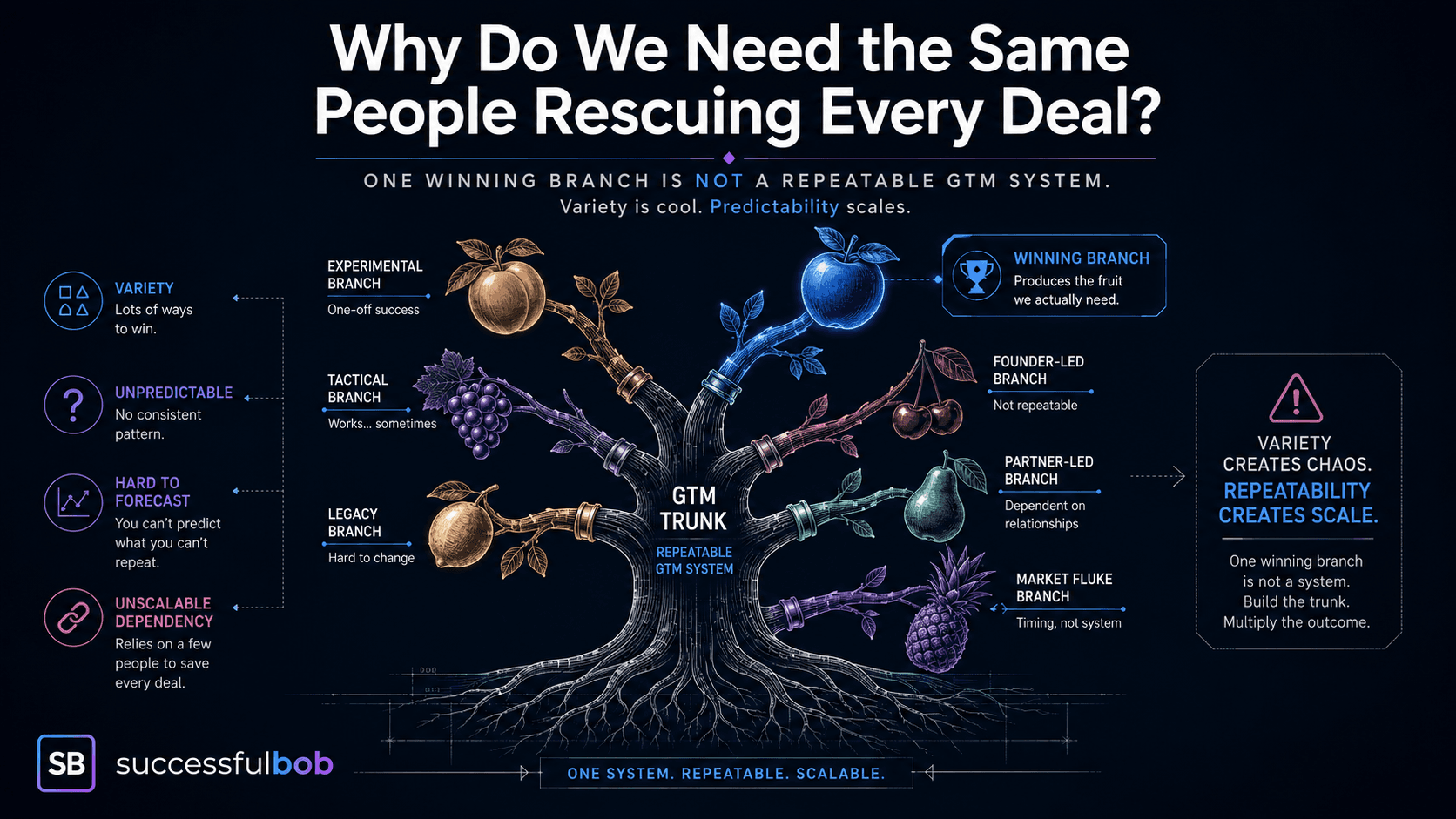
If the same person keeps getting pulled into important deals to solve the same problem, your go-to-market motion has a repeatability gap. That person may be a founder, CPO, principal SE, standout rep, or anyone else the team trusts to “fix the thing.” The useful question is not just why they are so effective. It is what they consistently contribute that the rest of the GTM system cannot yet reproduce.
Maybe it’s the founder. The CPO. The principal SE. The particularly smart, funny, high-social-EQ person who can somehow pull everything together and get it across.
When the deal gets difficult, everybody knows what happens next.
“Get them on the call.”
Having someone like that is great.
Needing them every time is not.
First, figure out what they’re actually rescuing
The thing they fix will be different from company to company.
Maybe the product gets explained correctly, but nobody besides this person can make the buyer understand why it matters.
Maybe the buyer gets nervous about the price and this person can finally connect the value strongly enough to get past it.
Maybe every security or compliance conversation goes sideways until one particular technical person shows up.
Maybe the team knows the product, but the buyer just doesn’t have confidence in the answers until this person delivers them.
Whatever it is, pay attention to the thing.
If the same person consistently gets called in to address the same weakness, that is gold.
They are showing you where your GTM motion is breaking.
Sometimes the person really is just that good
There is an important distinction here.
If someone gets brought into difficult deals and helps for a hundred different reasons, you may simply have a gifted gem.
They read the room. They know when to push. They know when to shut up. They can talk to an engineer, a CFO, and a procurement person without sounding like three different people.
Great.
Pay them more.
Have them mentor people.
Hire more people who share the characteristics that make them effective.
But if they keep getting pulled in for the same reason, something different is happening.
They aren’t just helping you.
They’re enabling you.
And that part is on you, not them.
Stop being enabled. Learn from it.
Your GTM motion shouldn’t fail the bus test
Eventually, this person becomes him or her, as the kids say these days.
Everybody knows.
“Oh, get Sarah involved. She’s amazing at these.”
Cool and all.
But now you fail the bus test.
If Sarah gets hit by a bus tomorrow, are you toast?
Hopefully Sarah does not get hit by a bus. Maybe she merely wins the lottery and decides she never wants to hear the words “enterprise sales cycle” again.
The business problem is the same.
You allowed an important capability to remain attached to one person instead of becoming part of the organization.
One amazing branch can only produce so much fruit
Think about a fruit cocktail tree.
You can graft several different kinds of fruit onto one tree. One branch might grow peaches. Another plums. Another apricots.
That is really cool if what you want is variety. It may even have some interesting botanical or pollination benefits.
It is considerably less cool if you’re trying to operate Bob’s Bountiful Banana Boutique and only one branch of the tree grows bananas.
That branch might grow the finest bananas anyone has ever tasted (which is odd considering all bananas are literal genetic clones).
You still have a problem.
You can only sell as many bananas as that branch can produce.
Your ability to scale is constrained by the branch.
Your forecast is constrained by the branch.
And if a freak ice storm takes out that one branch, which is admittedly some spectacularly bad luck for a banana-based business, you’re toast.
Again.
That’s what happens when one person owns a capability that your GTM system actually needs.
Look for the pattern, data nerds
This is a fantastic time for a spreadsheet.
Or a Venn diagram, if you’re one of those people. (I’m one of those people.)
Look at the deals where your designated rescuer got involved.
What was happening before they joined?
Why were they brought in?
What did they actually contribute?
What changed afterward?
Then look for patterns.
If the pattern is simply that this person is unusually personable and can talk to anyone about anything, that’s useful information. Have them mentor other people. Study what makes them effective. Look for similar characteristics when you hire.
But if particular topics keep appearing, you probably have a GTM problem.
Something is falling through the gaps.
Start at Product Truth.
Does everyone actually agree about what the product does, who it serves, where it wins, what it cannot do, and what its boundaries are?
If that’s solid, move up through translation.
Can the rest of the organization connect those product truths to the problems different buyers care about?
Then look at your value mapping, messaging, conversations, demos, objections, and enablement.
Somewhere along that path, information is failing to make it to all the other branches not named banana.
Sometimes the winning branch grew by accident
This doesn’t always mean the company failed to document something obvious.
Sometimes the person themselves discovered something new.
I’ve been that branch.
I once supported all of the channel partner managers for a company as the Channel SE. That meant I could spend four to six hours a day doing demos and customer conversations, several days a week.
When you get that many repetitions, something inevitably happens.
You say something and notice that it lands.
So you try it again.
Then you change a word.
You move it earlier in the conversation.
You connect it to a different example.
You refine it, and refine it, and refine it.
Eventually, you have something incredibly effective that feels completely natural because you’ve done it hundreds of times.
But nobody necessarily says:
“Wait. Bob figured something out. We should bring this back into the system.”
There’s nothing malicious about it. It just happens.
The branch grew.
The problem is that nobody grafted what it learned back into the trunk.
Someone outside that branch needs to recognize what is happening, capture the insight, test whether it works for other people, and feed it back through Product Truth, messaging, enablement, or wherever it belongs.
Otherwise you have one person who seems inexplicably better at this than everyone else.
Can you name your person?
Here’s the easiest diagnostic I can give you.
Who is the person your team calls when an important deal needs rescuing?
If you can name them in about three seconds, you probably have this problem.
If you can’t, great.
Also, why did you read this far?
If someone immediately came to mind, start documenting what they get pulled into this week.
Don’t just record that they joined the call.
Write down why they were needed and what they contributed.
Do the same thing next week.
Then look for the pattern.
Because the goal isn’t to get rid of your best branch.
It’s to figure out what makes that branch produce so well, and make sure the rest of the tree can benefit from it.
And if you collect the data but can’t see the pattern, DM me on LinkedIn. I’m happy to take a look at it with you.