
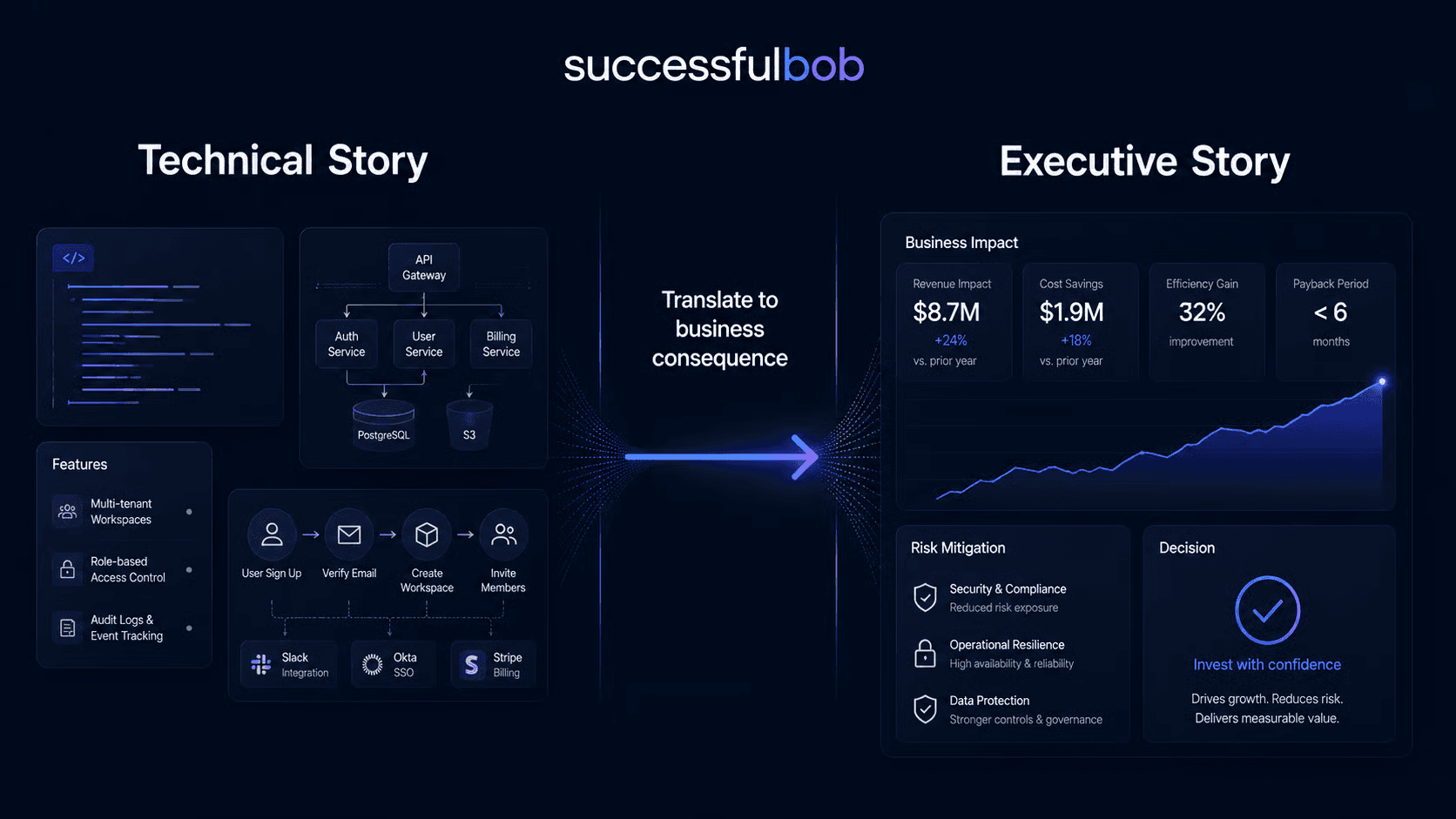
A technical story explains what the product does. An executive story explains what business outcome is at stake, why it matters now, and what decision needs to be made.
Technical companies often miss that difference.
They get in front of an executive and default to the standard product pitch: what was built, how it works, why the architecture is strong, what the roadmap looks like, how it compares to competitors, and what the license costs.
Some of that may matter later.
But it is rarely where the executive story should start.
An executive is usually not trying to become an expert in your product. They are trying to understand whether this purchase helps them create a positive business outcome or avoid a negative one. If it does, they need to know whether it is urgent, what they need to do, and when the decision needs to move.
If your story does not answer those questions, you may have explained the product well and still missed the executive conversation.
Product details are not executive value
A technical story is usually built around the product.
What does it do? How does it work? Why is it credible? How is it delivered? What makes it different?
That story matters. It helps technical champions decide whether the product is real, usable, secure, scalable, or feasible.
But an executive usually does not care about a feature because it is a feature. They care because that feature changes something the business cares about.
Risk.
Compliance.
Revenue.
Competitive advantage.
New market entry.
Cost control.
Operational leverage.
Customer impact.
Time savings in M&A.
Board visibility.
Job security.
The airspeed of an unladen swallow may be interesting to someone, somewhere, but it is probably not moving the executive buyer.
The executive story has to move from product detail to business consequence.
The question is not, “What does our product do?”
The question is, “What does this executive need to improve, protect, accelerate, reduce, or decide?”
That is the translation step.
The executive story needs a job
A good executive story should make three things clear:
1.What does the executive need to know?
2.What is expected from them?
3.When does it need to happen?
If those questions are not answered, the meeting probably did not do its job.
Getting executive attention is hard. Once you have it, the executive should understand why the decision matters, what decision is being asked for, and what timeline is attached to it.
That does not mean every executive meeting needs to end with a signed contract.
It may mean they need to sponsor the initiative, approve the direction, assign the right team, fund the evaluation, bring in another stakeholder, or commit to a timeline.
The point is that the conversation should create movement.
If the executive leaves thinking, “Interesting, I’ll get back to this later,” there is a good chance later never happens.
Do not make it fluffy
The answer is not to strip out all substance and replace it with vague business language.
That usually sounds like transformation, innovation, modernization, alignment, and strategic value.
Fine words.
Often useless by themselves.
An executive story still needs teeth. It needs a real business problem, a real consequence, a real timeline, and a real reason to act.
It also needs enough technical truth underneath it to be credible.
Use enough technical detail to prove the outcome can actually be delivered. Not enough that the executive could guest lecture on your behalf at MIT.
That is the balance.
Too technical, and the executive has to do the business translation alone.
Too vague, and the story feels theoretical.
The executive story should be simple, but not empty.
Urgency should come from their timeline, not yours
A lot of companies try to create urgency from the vendor side.
End-of-quarter pricing.
Implementation availability.
A product launch.
A sales campaign.
Those may matter to you. They may not matter to the executive.
Stronger urgency usually comes from the executive’s own timeline.
If they are responsible for M&A integration, how many acquisitions are they trying to integrate this year? When does the operating model need to be ready?
If they are facing a regulatory requirement in January, when does the solution need to be implemented for them to be compliant?
If they are entering a new market, what has to be in place before that market push becomes real?
If they are trying to reduce risk before a board review, what will the board expect to see and by when?
Your timeline is not the center of the story.
Theirs is.
The story has to change by audience
A technical champion and an executive buyer do not need the same story.
A technical champion may need to understand integration, implementation, security, workflow fit, reliability, and day-to-day operational impact.
An executive buyer needs to understand business value, risk, urgency, decision ownership, cost of inaction, and the next move.
You are not changing the truth.
You are changing the translation.
Sell to the audience’s pain, not to your favorite features.
The only time one pitch works for every stakeholder is when you are selling to a single-member LLC. In that case, congratulations. You have a buying committee of one.
For everyone else, the story needs to adapt.
A simple executive-readiness test
Here is a fast way to test whether your story is executive-ready.
Pick an executive title from a hat, a spinner, or whatever ridiculous method keeps the team honest.
Give yourself two minutes.
Explain why your product helps that executive accomplish something they care about, what they need to do, and when they need to do it.
Then go to your AI tool of choice and ask:
“What are the top five concerns a [CXO title] would care about related to [your product category] over the next [timeframe]?”
Now compare.
Did your two-minute story mention any of those concerns?
If yes, you may be mapping to real executive pain.
If it took you two and a half minutes, you probably failed. The executive is checking email.
If you did not give a timeline, you probably failed. The executive has mentally filed it under, “I’ll get to this some other time,” which often means they will forget about it.
This exercise is simple, but it exposes a lot.
If the team cannot quickly explain why the product matters to a specific executive, the story is probably still too product-centered.
Product truth comes first
An executive story still starts with product truth.
Product truth tells you what the product can actually deliver. Deliverable features support real workflows. Supported workflows map to business value. Business value is what executives speak in.
If you skip that chain, the story gets weak.
You either end up with technical detail that never becomes business value, or executive-level language that is too fluffy to believe.
The best executive narratives are grounded in what the product truly does, but they do not stop there. They carry the product truth all the way to the workflow, the business concern, the measurable value, and the decision the executive needs to make.
That is the difference between a technical story and an executive story.
The technical story says, “Here is what we built.”
The executive story says, “Here is the business outcome this helps you create or protect, why it matters now, and what needs to happen next.”
Technical companies need both.
But if you are talking to an executive and only telling the technical story, you are asking them to do too much translation.
Most will not.
They will move on to the next thing that already sounds like their problem.
Need help turning product truth into an executive story?
Production Ready helps technical companies turn product depth into buyer-ready messaging, executive narrative, demo flow, partner story, and field repeatability.
If your technical story is accurate but not landing with executives, the next step may be building the business story that gives the product a reason to matter at the decision-maker level.
Schedule a 30-minute fit call: https://calendar.app.google/7whsjgVTFPQNQ7oE6