
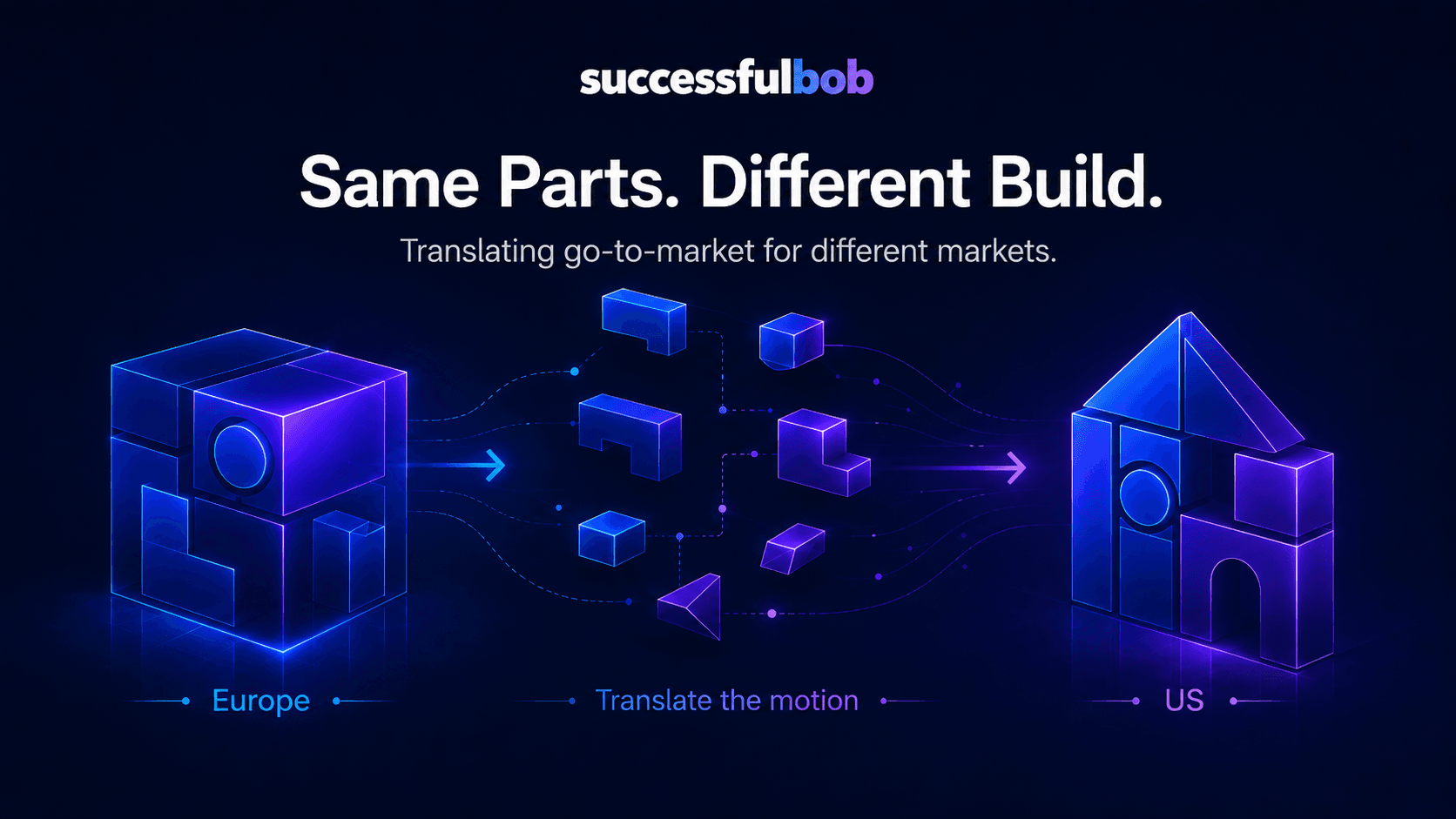
No. A company should not use the exact same go-to-market strategy in the US and Europe. The underlying product, competitive advantages, and much of the value story may stay the same, but buyer urgency, risk tolerance, partner behavior, regulation, market structure, and sales execution differ enough that the motion needs to be rebuilt for each market. Think of it like a LEGO Creator 3-in-1 kit: same pieces, different build.
Keep the truth. Rebuild the motion.
A company entering the US should not throw away everything that worked in Europe.
Start by separating what is fundamentally true from what only worked because of the environment around it.
- What the product does and does not do
- Where it has a real competitive advantage
- Which capabilities create meaningful customer value
- The proof required to demonstrate that value
- The need for trusted partners and executive-level messaging
Those are the bricks.
What changes is how you arrange them around local buying behavior, risk tolerance, urgency, procurement, competition, partners, and market structure.
A US buyer may recognize the exact same product value as a European buyer and still make a completely different decision.
European urgency does not automatically travel
European companies often operate under external forces that help create urgency.
Regulation, compliance, data protection, sustainability requirements, emissions goals, and industry mandates can make the cost of waiting much easier to explain.
The European Commission describes the EU single market as a borderless economic area that supports the free movement of goods, capital, services, and people. That does not erase country-level differences, but it does create more cross-border commercial infrastructure than many smaller US companies typically encounter. European Commission: Single market: https://commission.europa.eu/topics/single-market_en
The US does not always hand you that same urgency.
A message built around sustainability, emissions, or regulatory readiness may be important to some American buyers, but it may not control the purchasing decision. The executive signing the check may care more about revenue, cost reduction, operational risk, staffing, speed, or avoiding an expensive failure.
That can feel uncomfortable because it reveals how capitalistic the US market really is.
Being responsible may help your case. Saving or making money usually makes it much stronger.
In Europe, an external deadline may create the pain for you.
In the US, you often have to do more work to show why doing nothing is expensive.
The US is not simply a larger version of one European country
European companies may already be accustomed to adapting across borders, languages, regulations, and local partner relationships.
The US creates a different challenge. It is one large domestic market, but it is fragmented by industry, state, region, company size, procurement model, and buyer maturity.
A healthcare buyer in rural Maine may behave very differently from a national financial institution in New York. A public university does not buy like a technology company. A regional hospital may have grant funding, staffing problems, and operational pressures that do not exist in a Fortune 500 enterprise.
The same product may fit all three.
That does not mean the same message will move all three.
This is why “the US market” is usually too broad to be a useful initial target.
Partners behave differently too
In Europe, companies often build through smaller localized partners with strong customer relationships, regional credibility, and an interest in long-term account development.
Those partners may provide attention because the relationship matters to them.
In the US, many of the largest partners operate on scale. They have enormous catalogs, many competing vendors, and limited incentive to create your market for you.
They can provide reach, but reach is not the same as attention.
A large national partner may be perfectly happy to add your product to its portfolio. That does not mean its sellers will remember it when a customer describes the problem you solve.
The product may need to commercialize itself before a large partner meaningfully accelerates it.
That is why a smaller US partner can sometimes be more valuable than a famous one. A boutique partner with trusted relationships in the right vertical may give you mindshare, help sharpen the story, identify real opportunities, and bring you into accounts where the pain already exists.
The question is not how many partners you have signed. It is which partners are repeatedly putting you in front of the right buyer with a problem important enough to solve.
Every additional partner also dilutes the investment available to the partners you already have. More is not automatically better.
Lots of activity can hide a weak motion
The easiest warning sign is activity without revenue.
People take your meetings. Partners attend enablement. Prospects accept demos. Events generate badge scans. The pipeline grows.
Everyone feels busy.
But deals do not move.
That activity can falsely validate the strategy. It tells you the market is willing to listen, but not that you have convinced anyone of necessity or urgency.
A prospect hearing about your company for the third time without understanding why they need to act does not become three times more interested.
They become desensitized.
The common response is to increase activity:
- Hire more account executives
- Add more business development
- Enter more markets
- Attend more events
- Sign more partners
- Generate more pipeline
That can make the problem worse.
You are scaling a motion that has not yet become precise enough to convert.
Start with one European motion that already works
Do not begin by rebuilding the entire US strategy.
Pick one of your strongest European motions and dissect it.
Ask:
- What specific pain is being addressed?
- What creates urgency?
- Is regulation helping create that urgency?
- Which buyer is most motivated?
- Is there a repeated vertical or market segment?
- Does the same type of partner keep appearing?
- What is that partner contributing beyond access?
- Which product capabilities provide the evidence needed to close?
- What happens if the customer does nothing?
Now reconstruct the motion for the US.
Where can you find a buyer with a similar level of pain?
That may require choosing a particular vertical, company size, geography, or operating environment rather than targeting the entire country.
Then look for a partner that can reproduce the most valuable part of the European relationship.
Was the European partner successful because of its size, or because your product stayed top of mind? Did it have trusted customer relationships? Did it understand a particular industry? Did its sellers recognize the pain quickly?
A smaller US partner may reproduce those conditions better than a national catalog company.
Then redefine the buyer.
Who is the actual human being experiencing the pain in the US? What are they measured on? What makes the issue urgent to them? What risk are they personally trying to avoid?
Finally, rebuild the demo around that person.
Do not show them everything the product can do. Show the evidence required to prove that you can fix the problem they already care about.
Your operating system matters more when people move
A market strategy that exists mostly inside a few leaders’ heads is fragile anywhere.
It is especially fragile in a labor market where people change roles regularly. The US Bureau of Labor Statistics reported that private-sector employees had a median tenure of 3.5 years with their current employer in January 2024. US Bureau of Labor Statistics: Median tenure in the private sector: https://www.bls.gov/opub/ted/2025/median-tenure-with-current-employer-was-3-5-years-in-private-sector-in-january-2024.htm
That makes repeatability important.
Your US motion cannot depend on one executive remembering why a vertical was selected, one salesperson knowing the best story, or one partner manager understanding which relationships actually produce revenue.
Product Truth, value translation, messaging, demo logic, partner selection, and field feedback need to become a shared system.
Otherwise, each new hire starts rebuilding the strategy from memory.
Same bricks. Different build.
The mistake is not bringing your European experience into the US. The mistake is assuming the finished structure should look the same.
Keep the Product Truth. Keep the competitive advantages. Keep the strongest value translation and proof.
Then reconsider the forces surrounding the buyer:
- What creates pain?
- What creates urgency?
- Who carries the risk?
- Which partner earns attention?
- Which vertical experiences the problem consistently?
- What evidence does the buyer need before acting?
- What makes doing nothing unacceptable?
The US strategy should be related to the European strategy. It should not be its identical twin.
A practical place to start is to take one European motion that already produces revenue and rebuild it for one carefully selected US buyer, vertical, and partner. That exercise will tell you more than adding another seller, event, market, or reseller to a motion that has not yet converted.
Activity without momentum usually points to a precision problem, not an effort problem.
Production Ready helps technical companies identify whether the gap is in Product Truth, value translation, field execution, partner repeatability, or ownership. Learn more at https://www.successfulbob.com
Sources
- European Commission, “Single market”: https://commission.europa.eu/topics/single-market_en
- US Bureau of Labor Statistics, “Median tenure with current employer was 3.5 years in private sector in January 2024”: https://www.bls.gov/opub/ted/2025/median-tenure-with-current-employer-was-3-5-years-in-private-sector-in-january-2024.htm